


Files
Download Full Text (624 KB)
Date of Graduation
5-2027
Description
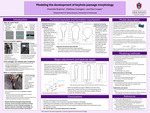
Cave passage morphology is an important indicator of the hydrological conditions under which a cave passage was formed. Keyhole passages are a commonly occurring type of passage morphology that consists of a round, wide top with a smaller canyon incised in the bottom of the passage. These passages typically indicate a shift from fully water-filled to partially water-filled conditions. There are multiple mechanisms by which such a transition can occur, and little is understood about which of these mechanisms is most common, or whether aspects of keyhole passage morphology may indicate the primary formation mechanism. CaveCHAMP is a physically based cave evolution model that can simulate the evolution of passage shape along an extended conduit, including effects of ventilation and CO2 dynamics in the air-filled portion of the cave. We have found several ways to model keyhole passage formation using CaveCHAMP, including manipulating discharge and chemistry. To quantify changes in cross section shape, we have developed a set of parameters to describe the shape of the cross section. These parameters quantify several key characteristics of a keyhole-shaped cross section, including the relationship between the widths of several parts of the passage. We have simulated the changes to keyhole morphology along a conduit and shown that the cross section maintains its geometry throughout the passage when created by a sudden decrease in discharge. In contrast, the keyhole widens and becomes less distinct upstream when created by base-level fall. We have also discovered that the distinctiveness of a keyhole shape is controlled by the timescale during which the transition from water-filled to partially water-filled occurs. These differences in morphology indicate that field observations of keyholes may allow us to constrain the conditions under which they formed. Utilizing cave passage morphology could be key in understanding past hydrologic conditions in areas where traditional hydrological indicators are absent.
Publication Date
2026
Document Type
Poster
Degree Name
Bachelor of Science in Geology
Degree Level
Undergraduate
Department
Geosciences
Advisor/Mentor
Covington, Matthew
Disciplines
Geology
Keywords
Natural Science
Citation
Boehme, C. (2026). Modeling the Development of Keyhole Passage Morphology. 2026 Research Poster Competition. Retrieved from https://scholarworks.uark.edu/hnrcsturpc26/16

