


Files
Download Full Text (435 KB)
Date of Graduation
5-2026
Description
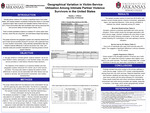
Intimate partner violence (IPV) is a persistent public safety and public health issue in the United States. Women in rural areas, particularly in the Southern United States, experience disproportionately high levels of frequency and severity. Prior research shows that as communities become more rural, survivors face greater risks of severe violence alongside fewer available support services. This study examines how geographic location shapes help-seeking behaviors and access to victim service providers among adult IPV survivors, with particular attention to differences between rural, suburban, and urban areas in the South. Using nationally representative data from the National Crime Victimization Survey (NCVS) from 2021 to 2023, this research analyzes incidents of intimate partner violence among adult women. The analysis incorporates reporting outcomes, law enforcement involvement, severity and type of violence, and key victim and offender characteristics. Geographic location is classified to compare rural, suburban, and urban areas, with additional comparisons between Southern and non-Southern regions. Descriptive and comparative statistical techniques are used to identify patterns in reporting behavior and utilization of victim service providers, such as shelters, legal aid, and advocacy organizations. Preliminary findings suggest that survivors in rural Southern areas are less likely to access formal victim service providers than their urban counterparts, despite experiencing higher levels of violence severity. Instead, rural survivors appear more likely to rely on law enforcement as their primary point of intervention. This pattern aligns with existing research describing rural communities as “service deserts," where long travel distances, limited funding, and a scarcity of social service organizations restricts survivors' options for support. Early results also indicate that the availability of services alone does not fully explain help-seeking behaviors. Factors such as law enforcement capacity, social norms, and the nature of the abusive incident may play an equally important role. These findings have real world implications for improving IPV responses in under-resourced communities. By identifying where and how survivors seek help, this research can inform policy efforts aimed at strengthening coordination between law enforcement and victim service providers, expanding service delivery, and tailoring intervention strategies to reflect the lived experiences of women in the rural South. More broadly, this study contributes to sociological research on inequality, rural justice systems, and gender-based violence, offering insight into how structural barriers shape survivors' access to safety and support. Final results will be available upon the completion of the full analysis in March 2026.
Publication Date
2026
Document Type
Poster
Degree Name
Bachelor of Arts in Sociology
Degree Level
Undergraduate
Department
Sociology and Criminology
Advisor/Mentor
Bradley, Mindy
Disciplines
Sociology
Keywords
Social Science
Citation
O'Brien, N. (2026). Rural Women and Intimate Partner Violence: A Geographical Analysis of Victim Service Providers in the Southern United States. 2026 Research Poster Competition. Retrieved from https://scholarworks.uark.edu/hnrcsturpc26/2

