


Files
Download Full Text (364 KB)
Date of Graduation
5-2027
Description
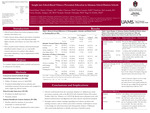
Insight into School-Based Tobacco Prevention Education in Arkansas School Districts [PD1] Henry Obajaja, Ashley Clawson, Kara Lasater, Victor Kwaku Akakpo, Kolade Olatunde, Luke Larsen, Faisal Khan, Page D Dobbs Characters: 2,500/2,500Select Category: Public Health Study Type: Cross-sectionalPresentation Type – Paper or Poster Funding – select University (College of Education and Health Professions WE CARE Initiative) Significance. Despite national declines in youth tobacco use, Arkansas, a Tobacco Nation state, continues to report disproportionately high rates of tobacco use among adolescents. Prior research found Arkansas school professionals identified student tobacco use as a top health concern; however, it is unclear what tobacco prevention education, if any, is implemented within these schools. This study examined Arkansas school personnel’s awareness of and involvement with evidence-based tobacco prevention education. Method. A convenience sample of school personnel (e.g., teachers, administrators, and staff) from K-12 schools in Arkansas (n=325) completed a cross-sectional survey that asked questions about the tobacco prevention curriculum used, need for teacher training to deliver tobacco prevention education, and perceptions of how well their school integrated tobacco prevention strategies. Participants were grouped by their role in implementing tobacco prevention education: (1) not part of their assignment, (2) not assigned to educate but did anyways, and (3) assigned to educate about tobacco prevention. Chi-square tests examined associations between personnel roles and prevention practices employed, and ANOVAs assessed differences in personnel roles and perceptions of policy integration (how well they believed the school integrated ….) Result. The study revealed that only 29% of respondents reported using a premade tobacco prevention curriculum, 28.7% used a non-premade curriculum, and 41.3% reported none. There were significant associations between personnel roles and awareness of prevention curriculum used in one’s school (p< .001), belief in the need for specific teacher training (p< .05), and receipt of prevention-related training in the past three years (p< .001). Overall, 49% of those who were assigned to teach reported using or not using a premade curriculum, while 24.7% of those who were not assigned but ended up teaching reported using a premade curriculum. Further, those assigned to teach prevention reported significantly higher perceptions of research-based curricula (p< .05), cessation services (p< .05), prevention in academics (p< .05), and school tobacco specialists (p< .05). Implication. Few Arkansas schools are implementing evidence-based tobacco education curricula. There is a need to implement evidence-based tobacco prevention curricula, provide comprehensive teacher training, and integrate prevention throughout academics to reduce youth tobacco use.
Publication Date
2026
Document Type
Poster
Degree Name
Bachelor of Science in Biology
Degree Level
Undergraduate
Department
Biological Sciences
Advisor/Mentor
Dobbs, Page
Disciplines
Biology
Keywords
Health
Citation
Khan, F. (2026). Insight into School-Based Tobacco Prevention Education in Arkansas School Districts. 2026 Research Poster Competition. Retrieved from https://scholarworks.uark.edu/hnrcsturpc26/20

