


Files
Download Full Text (672 KB)
Date of Graduation
5-2028
Description
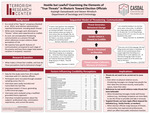
Threats of violence have become increasingly visible, yet they remain understudied compared to acts of violence themselves. This project examines death threats directed at U.S. election administrators following the 2020 Presidential Election. Drawing on qualitative interviews with 26 current and former U.S. election administrators, I analyzed 580 hostile messages received in the aftermath of the election to understand how threats function as a tool of intimidation and coercion. Messages were examined for markers indicating (1) whether the sender expressed the intent to threaten, (2) whether the language specified a concrete act of violence or identifiable target, and (3) whether a reasonable person in the recipient’s position would experience fear of imminent harm. Rather than treating threats as a binary category, I analyze how extremist rhetoric frequently approaches, but does not cross, the legal threshold of a prosecutable threat. This approach allowed me to assess how threatening communications operated along a spectrum rather than as a discrete event.Findings reveal that most messages lacked one or more elements required to constitute a “true threat.” While only a small proportion of messages (~5%) met all three criteria of intent, specificity, and reasonable fear, the majority contained violent language that stopped short of explicit threat-making. Nearly 57% of messages fell into a category of “cyberbullying,” while an additional 38% constituted “violent talk.” These messages frequently conveyed anger, moral judgment, or implied harm while avoiding details that would elevate them to a legally actionable threat. The results suggest that senders engaged in boundary-pushing behavior by using ambiguity to intimidate election officials. Overall, this study highlights the gap between legal definitions and lived experiences of intimidation. Even when communications did not qualify as true threats, participants reported fear, stress, and professional disruption, which can undermine institutional stability and democratic participation. By empirically demonstrating that most hostile messages avoid breaching the legal threshold, the results provide an evidence base for policy reforms that address patterned intimidation, rather than isolated statements. Policymakers could use these findings to enhance workplace protections or harassment statutes that account for repeated boundary-pushing behavior even when individual messages do not qualify as true threats.
Publication Date
2026
Document Type
Poster
Degree Name
Bachelor of Arts in Criminology
Degree Level
Undergraduate
Department
Sociology and Criminal Justice
Advisor/Mentor
Windisch, Steven
Disciplines
Social and Behavioral Sciences
Keywords
Social Science
Citation
Gwiazdowski, K. (2026). Hostile but Lawful? Examining the Elements of “True Threats” in Rhetoric Toward Election Officials. 2026 Research Poster Competition. Retrieved from https://scholarworks.uark.edu/hnrcsturpc26/40

