


Files
Download Full Text (483 KB)
Date of Graduation
5-2029
Description
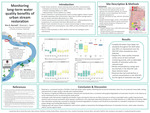
Urbanization without conscious environmental planning can result in the degradation of stream ecosystems. This tends to result in urban stream syndrome, which is often characterized by increased sediment and nutrient concentrations, decreased biodiversity, more frequent flash flooding, and overall water quality degradation. As such, stream restoration practices are often implemented to address urban stream syndrome. Commonly used restoration practices include applying natural channel design to stabilize eroding stream banks and establishing diverse streamside vegetation to filter pollutant inputs. However, the benefits of restoration are not often quantified due to a lack of post-restoration monitoring, making it challenging to determine what restoration success looks like. Therefore, we monitored Mullins Creek, a partially restored urban stream in Fayetteville, Arkansas, for physical and chemical parameters. We sampled five sites in the watershed - two sites upstream of the unrestored reach, one site within the restored reach, and two downstream sites - for dissolved oxygen, nutrients including nitrate + nitrite (NO3-N + NO2-N), ammonium (NH3-N), and soluble reactive phosphorus, specific conductivity, temperature, and turbidity from 2023-2024. Importantly, there has been no active maintenance of the restoration since its establishment. Ten years post-restoration, we found that all parameters met Clean Water Act standards in 2024, including turbidity which exceeded limits in 2023. We did document substantial variation in nutrient concentrations between years, with phosphorus and nitrate showing fewer extreme values in 2024 compared to 2023. The year-to-year variability indicates that the restoration may no longer be resilient and able to maintain water quality under typical year-to-year hydrologic variation. This variation in water quality in Mullins Creek suggests that initial restoration benefits may degrade without continued management, highlighting the need for adaptive maintenance strategies to sustain water quality improvements in urban streams.
Publication Date
2026
Document Type
Poster
Degree Name
Bachelor of Science in Agriculture
Degree Level
Undergraduate
Department
Agricultural, Food and Life Sciences
Advisor/Mentor
Speir, Shannon
Disciplines
Life Sciences | Water Resource Management
Keywords
Natural Science
Citation
Burnett, K. (2026). Monitoring long-term water quality benefits of urban stream restoration. 2026 Research Poster Competition. Retrieved from https://scholarworks.uark.edu/hnrcsturpc26/47

