


Files
Download Full Text (794 KB)
Date of Graduation
5-2026
Description
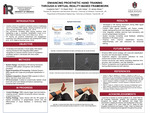
Enhancing Prosthetic Hand Training Through a Virtual Reality–Based Framework Integrated with the Coapt Control System. Ojoh, I.1,2, Shell, A.1, Asbee, J.1, Aguilar, D.1 ,Abbas, J.1,2, 1Institute for Integrative and Innovative Research, University of Arkansas, Fayetteville, AR; 2Department of Biomedical Engineering, University of Arkansas, Fayetteville, AR Introduction: Advances in upper-limb prosthetic hardware have greatly improved strength, durability, and mechanical performance; however, achieving intuitive control of EMG-based myoelectric prosthetic hands remains a significant challenge for individuals with trans-radial amputations. These devices rely on electromyography (EMG) signals generated by residual forearm muscles, which require consistent and well-coordinated muscle activation. Many users experience difficulty developing reliable control strategies during early training, which can delay functional use and reduce confidence. Enhancing training approaches for myoelectric prosthetic hand use is therefore an important need for prosthetic care. Methods: This project, conducted at the Institute for Integrative and Innovative Research (I³R), presents a virtual reality (VR)-based framework designed to enhance training of EMG-based myoelectric prosthetic hand use through the integration of a clinically relevant EMG pattern recognition control system (Coapt, LLC) with an immersive VR environment developed using Unity Technologies. Forearm EMG signals were analyzed using the Coapt system to identify user-specific muscle activation patterns associated with functional pinch and wrist movements relevant to myoelectric prosthetic control. Initial signal processing and classification logic were developed in Python to prototype EMG-to-movement mappings and assess classification reliability. These validated EMG outputs were then translated into C# and integrated into Unity for real-time VR interaction. Within the VR environment, an anatomically normal virtual human hand was animated using Unity’s Animation and Animator systems, with predefined pinch grasp and pinch release motions representing functional task states. EMG signals classified by the Coapt system triggered transitions between these animations, allowing the virtual hand to respond directly to user muscle activation. This animation-based control strategy enabled smooth, anatomically realistic finger motion without explicitly scripting individual joint movements. Results: Preliminary results demonstrate that users can consistently trigger grasp and release actions through EMG input, with immediate visual feedback reinforcing the relationship between muscle activation and hand motion. The immersive VR environment supports repeated practice of functional tasks in a safe, low-fatigue setting, promoting improved EMG signal consistency and user confidence prior to physical prosthetic training. This framework highlights the potential of VR-based training as an effective adjunct to conventional rehabilitation methods for myoelectric prosthetic hand use and supports future development of personalized and remote training systems.
Publication Date
2026
Document Type
Poster
Degree Name
Bachelor of Science in Biomedical Engineering
Degree Level
Undergraduate
Department
Biomedical Engineering
Advisor/Mentor
Abbas, James
Disciplines
Biomedical Engineering and Bioengineering | Engineering
Keywords
Engineering
Citation
Ojoh, I. (2026). Enhancing Prosthetic Hand Training Through a Virtual Reality–Based Framework Integrated with the Coapt Control System.. 2026 Research Poster Competition. Retrieved from https://scholarworks.uark.edu/hnrcsturpc26/56

