


Files
Download Full Text (883 KB)
Date of Graduation
5-2026
Description
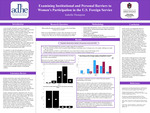
Gender equality and equal representation for women have become heavily debated topics in the global community over the last few decades. Some countries have constitutional policies in place that promote gender equality, while others have extreme gaps between the rights of men and women. One area commonly used to assess how far a country has progressed toward gender equality is women’s representation in government and politics. A growing body of scholarly research in International Relations and Foreign Policy Analysis examines the representation of women in foreign policy and diplomacy. Descriptive statistics show wide gaps between countries in women’s representation in government posts related to foreign affairs. In Scandinavian countries such as Sweden and Norway, women make up approximately 50% of ambassadors. Compared to these countries, the United States of America lags behind - women only make up about 34% of the ambassadors. The United States has had over 4,600 ambassadors since the State Department started sending diplomats abroad in 1893. Of these 4,600 representatives of the United States, only 9% of them have been women. This under-representation of women goes directly against the United States Foreign Service Act of 1980, which claims that the foreign service needs to be “truly representative of the American people throughout all levels.” At the same time, women constitute the majority in such fields as political science and international relations, which often lead to a career in foreign service. It is puzzling, therefore, why women continue to be underrepresented in foreign service posts. If women are the majority in the education systems that lead to a career in foreign service and there are no blatant policy barriers to women participating in the foreign service, then why are they not participating? In my research, I combine methods in policy analysis and political psychology to analyze the institutional and personal barriers obstructing women from participating in the foreign service. I have collected data from literature reviews, foreign policy analyses, and an original survey to support my four propositions: women feel as though they will experience sexism in the foreign service, women feel as though the foreign service does not promote work-life balance, women do not feel as though there are role models within the foreign service, and women do not feel as though they would be supported in the foreign service. My goal with this research is to have a better understanding of why there are gender disparities in the United States Foreign Service and what other countries are doing to combat this.
Publication Date
2026
Document Type
Poster
Degree Name
Bachelor of Arts in Political Science
Degree Level
Undergraduate
Department
Political Science
Advisor/Mentor
Bayram, A. Burcu
Disciplines
Political Science
Keywords
Social Science
Citation
Thompson, I. (2026). Examining Institutional and Personal Barriers to Women's Participation in the U.S. Foreign Service. 2026 Research Poster Competition. Retrieved from https://scholarworks.uark.edu/hnrcsturpc26/1

