


Files
Download Full Text (902 KB)
Date of Graduation
5-2026
Description
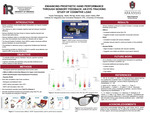
Modern prosthetic hands allow users to grasp and manipulate objects, but many users must constantly watch the device to complete even simple tasks. This heavy reliance on vision increases cognitive effort, slows movement, and makes prosthetic use feel less natural. An important question in prosthetics research is whether providing sensory feedback (enabling users to feel what the prosthetic hand is doing) can reduce this cognitive load and improve performance. In this study, sensory feedback refers to a system that provides clear tactile cues to the user upon contact between the prosthetic hand and an object, helping replace information normally felt through the natural hand. This study examines how sensory feedback influences cognitive workload during everyday hand use by analyzing eye movement behavior. Eye movements provide an objective and intuitive way to measure how much visual attention a person requires while completing a task. When tasks become easier and more intuitive, individuals tend to spend less time visually monitoring the hand and are able to visually explore other areas of the task space more efficiently. Methods:Participants complete standardized hand-function assessments, including the Southampton Hand Assessment Procedure (SHAP) and the Activities of Myoelectric Upper Limb Assessment (AMULA). These tasks are designed to reflect common daily activities such as grasping, lifting, positioning, and manipulating objects of varying sizes and shapes. Tasks are performed under three conditions: using the intact (non-amputated) hand, using a myoelectric prosthetic hand without sensory feedback, and using the same prosthetic hand with sensory feedback. Eye-tracking data are collected using Tobii Glasses 3 and analyzed in Tobii Pro Lab, where areas of interest, including the task objects and the hand, are defined to quantify visual attention patterns such as gaze duration, gaze shifts, and eye–hand coordination. Data are processed to remove recording artifacts and are visualized using plots and visual maps of gaze behavior to enable direct comparison across conditions. Results:It is expected that the presence of sensory feedback will reduce reliance on visual monitoring. This reduction is anticipated to appear as shorter and fewer visual fixations, faster coordination between visual attention and hand movement, and more efficient overall eye movement patterns. Performance with sensory feedback is expected to more closely resemble behavior observed when participants use their intact hand. The results of this research may help guide the design of future prosthetic devices by demonstrating how sensory feedback can reduce cognitive workload and improve functional usability. Ultimately, this work aims to support the development of prosthetic hands that are easier to learn, more intuitive to use, and better suited for everyday life.
Publication Date
2026
Document Type
Poster
Degree Name
Bachelor of Science in Biomedical Engineering
Degree Level
Undergraduate
Department
Biomedical Engineering
Advisor/Mentor
Abbas, James
Disciplines
Biomedical Engineering and Bioengineering | Engineering
Keywords
Engineering
Citation
Tchoungang, N., Dirrigl, H., & Asbee, J. (2026). Monitoring Eye Movements to Assess the impact of Sensory Feedback on Cognitive Workload During Myoelectric Prosthetic Hand Use. 2026 Research Poster Competition. Retrieved from https://scholarworks.uark.edu/hnrcsturpc26/54

