


Files
Download Full Text (3.1 MB)
Date of Graduation
5-2028
Description
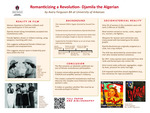
Romanticizing a Revolution Women’s participation in the 1954 Algerian Revolution became a signifier of the revolution itself. One woman- D’jamila Bouhired, became the mother of a movement and icon of the cause. However, D’jamila’s cause, the revolution, was not meant for her, nor the thousands of women who participated and gave their lives to decolonization. In this paper, I will examine the Egyptian film D’jamila, the Algerian, released in 1956. I will examine how film as a medium creates a fictional reality influenced by sociohistorical context yet is not always faithful to it. I argue that D’jamila, the Algerian portrays a differing reality from the sociohistorical context of the revolution as a means of strengthening Pan-Arabism. The reality of the Algerian revolution portrayed in the film shows women as an essential arm of the revolution; they are brutally involved and offer their lives daily. They carry weapons and know how to use them. They sneak bombs in breadbaskets throughout the maze of the city. They shoot men dead in dance clubs while parroting as dancers. They are kidnapped by the French, abused and tortured and raped in prison, then sentenced to death. Women cause an uproar of the entire male Algeria because their woman, Jamila, is prosecuted and murdered. Women are the martyrs that force the revolution. However, based on primary and secondary sources, the sociohistorical context and women’s participation in the revolution was different. Based on the historical reality, women were used to spy on the French, transport secret messages from revolutionary cells to the next. They would carry bombs and ammunition in breadbaskets. However, women were never given military leadership. They stayed in the domestic sphere simply transplanted to a revolutionary context. Women were not permitted to be trained in firing arms at camps- as the film portrays Jamila and her friends doing. The FLN did not support the total freedom of women or abolition of the patriarchy. They utilized the tools they had at their disposal and relied on the patriarchal attitudes of Western Europe to hoodwink the French. It was never an act of feminism, it was the logistics of decolonization. The creation of the film by Egyptian director Youssef Chahine speaks to the dissonance between realities. The film was created in response to the trials of D’jamila Bouhired where the French sentenced her to death. As an attempt to raise support for D’jamila, Egyptian directors, actors, and studios came together. However, the creation of the film was influenced by larger attitudes of Egypt’s push for Pan-Arabism. The film became a tool to garner sympathy and increase support for Algeria’s revolutionary mission. It centered the participation of women in fictional ways in order to mobilize an entire population.
Publication Date
2026
Document Type
Poster
Degree Name
Bachelor of Arts in Middle Eastern Studies
Degree Level
Undergraduate
Department
World Languages, Literatures and Cultures
Advisor/Mentor
Mahmoud, Rania
Disciplines
Arts and Humanities
Keywords
Humanities
Citation
Ferguson, A. (2026). Romanticizing a Revolution: Jamila, the Algerian. 2026 Research Poster Competition. Retrieved from https://scholarworks.uark.edu/hnrcsturpc26/21

