


Files
Download Full Text (1.3 MB)
Date of Graduation
5-2026
Description
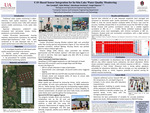
Current water quality assessment methods rely heavily on manual sampling and laboratory analysis, which are time-consuming and difficult to perform in remote or hazardous environments. In surface water monitoring, spatial and temporal resolution is often constrained by labor, access, and logistical limitations of manual sampling programs. This research aims to develop a drone-based system for real-time, in situ lake water quality monitoring. To address these challenges, the project focuses on integrating multiple water quality sensors, including oxidation-reduction potential (ORP), pH, electrical conductivity (EC), turbidity, and a multispectral spectrometer, into a compact, UAV-compatible design capable of collecting spatially referenced data. Methods: A multi-sensor water quality suite was designed and integrated using an Arduino-based data logging system capable of recording synchronized sensor measurements with GPS coordinates. A 3D-printed housing was fabricated for the multispectral spectrometer to minimize ambient light interference and improve measurement consistency. Sensors were programmed, tested, and validated through handheld probe testing and laboratory bench experiments. Future field deployment will involve mounting the sensor array onto a multirotor UAV to collect spatially tagged water quality data over Lake Sequoyah, with laboratory analysis used to validate in situ measurements. Preliminary Results: Preliminary work demonstrated successful integration and stable operation of all sensor modules under controlled conditions. The spectrometer housing reduced stray light exposure and improved repeatability, while synchronized sensor and GPS logging was achieved. Calibration testing identified sensor drift and noise as areas for further refinement prior to field deployment. Although airborne testing has not yet been conducted, bench-scale validation confirms system readiness for UAV integration. Discussion: This research represents a foundational step toward autonomous, UAV-based environmental monitoring systems. By mapping water quality across space rather than relying on single-point sampling, the system provides higher-resolution data capable of revealing gradients and localized anomalies in lake systems. Combining multispectral sensing with physical and chemical probes may enhance detection of nutrient concentrations and support early identification of harmful algal blooms. Overall, this work improves the efficiency, accuracy, and scalability of water resource assessment.
Publication Date
2026
Document Type
Poster
Degree Name
Bachelor of Science in Biomedical Engineering
Degree Level
Undergraduate
Department
Biomedical Engineering
Advisor/Mentor
Koparan, Cengiz
Disciplines
Biomedical Engineering and Bioengineering | Water Resource Management
Keywords
Engineering
Citation
Campbell, A. (2026). UAV-Based Sensor Integration for In-Situ Lake Water Quality Monitoring. 2026 Research Poster Competition. Retrieved from https://scholarworks.uark.edu/hnrcsturpc26/49

