


Files
Download Full Text (696 KB)
Date of Graduation
5-2027
Description
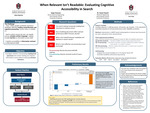
According to the World Health Organization, more than one billion people worldwide experience some form of disability. Many of them may affect cognitive processing and reading comprehension rather than vision or mobility, which creates barriers when accessing written information online. Web search is a critical modern literacy skill used for learning, decision-making, and everyday problem solving, yet most search systems are designed with the assumption that all users can process complex written language equally. As a result, people with dyslexia, other cognitive disabilities, low literacy levels, or who are English language learners may struggle to access relevant information even when it exists.This project examines how web search systems can be made more accessible by incorporating reading-level awareness into the ranking of search results. While accessibility research in computer science has traditionally focused on visual or motor impairments, cognitive accessibility and reading comprehension remain underexplored, particularly in information retrieval systems. Our goal is to investigate whether re-ranking search results based on users’ reading levels can improve access to information without reducing relevance.We design a cognitive-aware search framework that allows users to indicate a preferred reading level, such as grade level or language complexity. Documents in the search collection are indexed using an existing information retrieval model, ColBERT, and are labeled or generated at different reading levels. When suitable datasets are unavailable, large language models are used to create or find versions of documents with varying vocabulary complexity and sentence structure. We compare a standard relevance-based ranking approach with personalized ranking strategies that incorporate reading-level information.To evaluate system performance, we use established information retrieval metrics including precision, recall, and mean average precision. These metrics measure how accurately the system retrieves relevant documents and how early those documents appear in ranked results. Preliminary findings suggest that incorporating reading-level information meaningfully changes which documents are prioritized, often surfacing content that is easier to read while remaining relevant to the user’s query.In real-world settings, reading-level-aware search could support people with dyslexia, neurodivergent users, older adults, students, and individuals with low literacy, helping ensure that access to information is not limited by reading ability.
Publication Date
2026
Document Type
Poster
Degree Name
Bachelor of Science in Computer Science
Degree Level
Undergraduate
Department
Electrical Engineering and Computer Science
Advisor/Mentor
Gauch, Susan
Disciplines
Computer Sciences | Engineering
Keywords
Engineering
Citation
Frierson, K. (2026). When Relevant Isn’t Readable: Evaluating Cognitive Accessibility in Search. 2026 Research Poster Competition. Retrieved from https://scholarworks.uark.edu/hnrcsturpc26/65

