


Files
Download Full Text (1.6 MB)
Date of Graduation
12-2027
Description
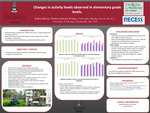
Background: Physical activity is important for children, recess is a great opportunity for physical activity, however, little is known how physical activity during recess changes throughout a school year, which is important for identifying key potential intervention points. Purpose: To determine how physical activity of elementary students changes throughout the school year. Methodology: This is a research-based, longitudinal, observational study design. Through local observations at a nearby elementary school, we can analyze the activity levels of elementary students. Trained research assistants conducted systematic research observation using SOPLAY (System for Observing Play and Leisure Activity in Youth) method. SOPLAY measures the grade level, activity level (sedentary, moderate, vigorous), weather, and location of activity. Training took place at the beginning of the school year and consisted of online and in-person training. I learned how to correctly identify the differences between activity levels and how to classify an activity within a certain range. During observations we scan left to right, scanning only females or only males on each scan. There is a specific rotation around the playground to follow and categorize the playground structures. The research team conducts observations regularly, unless weather or other reasons permits observations. Almost daily we have someone collecting data either at morning or afternoon recess, or both. The dependent variable is the percentage of children observed in vigorous, walking and sedentary activity. The independent variable is the time of the year being examined, divided into the categorical variable of months, which were compared using a linear regression. Results: We completed 22,841 playground scans. For all students, there were differences in percentage of students observed in vigorous, walking and sedentary by month (all p< .001). Vigorous activity was highest in November (27.0%), February (27.1%) and March (27.5%) compared to the lowest in April (22.4%). Walking was highest in February (41.9%) and March (38.9%) compared to the lowest in September (33.2%). Sedentary was highest in September (42.3%) and April (41.9%) compared to the lowest in February (30.9%). For girls only, vigorous activity was highest in November (25.0%) and March (22.3%), walking was highest in January (39.9%), February (40.9%) and March (39.2%), and sedentary was highest in September (45.7%) and April (46.4%). For boys only, vigorous was highest in January (33.9%) and March (32.6%), walking was highest in February (43.0%) and March (38.7%), and sedentary was highest in September (38.8%) and April (37.8%). Discussion: With these results we can differentiate how active kids are at different times of the year. Knowing this we can help to improve recess throughout the year to help keep all children active, for example introducing new equipment or creating structured activities during times when activity declines.
Funding Source: COEHP WE CARE Team Up Grant, Honors College Research Grants
Word Count: 439
Publication Date
Spring 4-20-2026
Document Type
Book
Degree Name
Bachelor of Science in Exercise Science
Degree Level
Undergraduate
Department
Health, Human Performance and Recreation
Advisor/Mentor
Howie-Hickey, Erin
Committee Member
Kaitlin Gallagher
Disciplines
Community Health and Preventive Medicine | Movement and Mind-Body Therapies | Public Health | Public Health Education and Promotion
Keywords
Research-Based
Citation
Harvey, K. R. (2026). Changes in activity levels observed in elementary grade levels.. 2026 Honors Symposium. Retrieved from https://scholarworks.uark.edu/coesym26/16
Included in
Community Health and Preventive Medicine Commons, Movement and Mind-Body Therapies Commons, Public Health Education and Promotion Commons

