


Files
Download Full Text (385 KB)
Date of Graduation
5-2026
Description
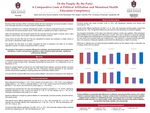
Background: In an increasingly polarized political climate and amid growing restrictions on reproductive healthcare, menstrual health education (MHE) has become both a public health and sociopolitical issue. Menstrual health is a foundational component of overall well-being and should be treated as a human right. However, it is frequently stigmatized, inconsistently taught, and often embedded within broader sexual education curricula. Political ideology influences educational policy, school standards, and public discourse surrounding reproductive health topics. Understanding how political party affiliation shapes perceptions of menstrual health education is critical to reducing stigma and promoting inclusive, evidence-based health education. Purpose: The purpose of this study was to examine differences in attitudes, perceived benefits, perceived barriers, self-efficacy, comfort, and perceived capability to teach menstrual health education, stratified by political party affiliation. Methods: A nationwide cross-sectional survey was conducted in September 2024 using a convenience sample of U.S. adults (N = 289) recruited through Prolific. Participants self-identified as Democrat (n = 115), Independent (n = 93), or Republican (n = 81). Measures included adapted constructs from the Health Belief Model (attitudes, perceived benefits, perceived barriers, self-efficacy; α = .87) and domains from the Professional Learning Standards for Sex Education assessing comfort and perceived capability in teaching puberty and menstruation related content. One-way ANOVAs were conducted to examine differences across political affiliation, with post hoc comparisons performed when significant. Results: Significant differences emerged by political affiliation for total attitudes, perceived benefits, perceived barriers, and overall comfort. Total attitude scores differed significantly (F(2,286) = 29.136, p < .001), with Democrats (M = 4.10, SD = 0.88) reporting more favorable attitudes than Independents (M = 3.69, SD = 0.93; p = .008) and Republicans (M = 3.07, SD = 0.99; p < .001). Independents also reported more favorable attitudes than Republicans (p < .001). Perceived benefits differed significantly (F(2,286) = 16.033, p < .001), with Democrats reporting higher perceived benefits than Independents (p = .026) and Republicans (p < .001). Perceived barriers also varied (F(2,286) = 14.457, p < .001), with Republicans reporting more barriers than Democrats (p < .001). Overall comfort differed significantly (F(2,286) = 3.178, p = .043), with Democrats reporting greater comfort than Republicans (p = .045). No significant differences were found for total self-efficacy or perceived capability. Conclusions: Political affiliation is associated with differences in attitudes, perceived benefits, barriers, and comfort related to menstrual health education. However, similar levels of self-efficacy and perceived capability suggest shared confidence in addressing the topic. Ensuring access to accurate, comprehensive menstrual health education is a shared public health responsibility that transcends political affiliation and benefits individuals, families, and communities.
Publication Date
2026
Document Type
Book
Degree Name
Bachelor of Science in Exercise Science
Degree Level
Undergraduate
Department
Health, Human Performance and Recreation
Advisor/Mentor
Schmitt, Abigail
Committee Member
Richardson, Emily
Disciplines
Public Health
Keywords
Research-Based
Citation
Sims, S. J., Richardson, E., & Schmitt, A. C. (2026). Of the People, By the Party: A Comparative Look at Political Affiliation and Menstrual Health Education Competency. 2026 Honors Symposium. Retrieved from https://scholarworks.uark.edu/coesym26/20

