-
Duties to yourself
Julian Sommers
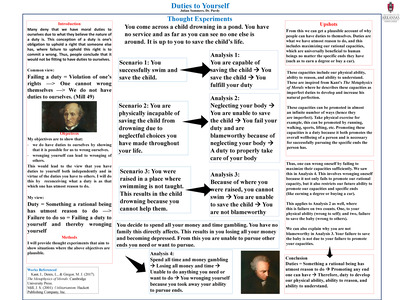
I will be writing a thesis paper with the guidance of Dr. Purdy so I can graduate from the honors program with a bachelor's within philosophy. This paper is still very much in the planning stages, but we have a rough idea of what it will look like. The broad topic is moral duties one could have to themselves and potentially how that relates to duties you might have to others as well. We are interested in this project because I believe our common idea of morality excludes the self from being regarded as a person. I believe morality focuses too much on how we should treat other people and not enough on how we should treat ourselves. This was the broad topic at the very start. There have been discussions all around this trying to polish what we would actually write about. My issue with what I said previously are the normative claims it makes. Saying this is how people “ought” to live presupposes that they want to live a good life or what I as well as many others regard as a good life. From this my stepfather suggested to write on a moral theory being brought up from the base that all humans want to preserve their lives. This comes from the fact that humans want to preserve their life, which seems to be a fact (at least for the very large majority) coming straight from our nature. From this we could start to derive a moral theory from the presupposition that you want to preserve your life. For example, I could say it is immoral for you to overindulge in junk food, not getting an adequate amount of physical activity to best promote your own physical health, and overindulging in activities that “rot” your brain/not promoting your mental health. All of these things would have to be fleshed out in much more detail. Taking it back to the start this could relate to duties you have to other people because if you fail these duties to yourself, it could lead to you potentially mistreating or not being in good enough shape to help when needed. My favorite example of this is if you see a drowning baby and you are the only one around for miles. The baby is in a position that any average conditioned person would be able to retrieve the baby, but since you failed your duty to maintain your own physical health you cannot save the baby. There are some counter examples and questions about this that I cannot get into right now. The money provided would be very beneficial to me because I struggle to pay for college, but specifically for the research I have needed to buy a lot of books outside of my classes to be able to compile relevant information to use in the paper. The books are not cheap, and any money would be greatly appreciated.
-
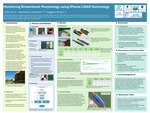
Monitoring Streambank Morphology Using iPhone LiDAR Technology
Lily C. Stitt
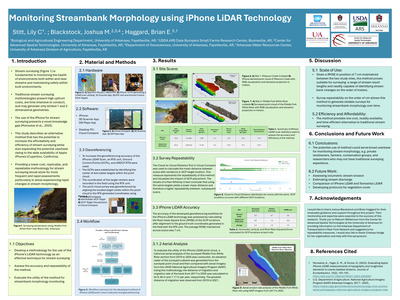
Monitoring stream morphology is crucial for maintaining the health and safety of fluvial environments, particularly as these naturally dynamic systems are shifted out of equilibrium due to climate and land-use change. Quantifying these changes in stream geometry is useful for infrastructure design, water quality assessment, water resource management, and stream restoration, among other applications. Traditional stream surveying methods contain limitations that inhibit affordable and accessible stream surveying needed for evaluating fluvial systems with high accuracy and large data samples. In recent years, several advancements have been made in the use of Light Detection and Ranging (LiDAR) technology as an alternative method for stream surveying, increasing the efficiency and accuracy of monitoring these systems. However, the accessibility of these methods is hindered by their high cost and the requirement of highly trained users. This study investigated the use of the Apple iPhone’s LiDAR scanning technology as an affordable and accessible alternative method for stream surveying. The objectives of this study were to develop a workflow for data collection with the iPhone LiDAR scanner and to assess the accuracy of the developed method. The iPhone LiDAR method was evaluated at three locations in and near Fayetteville, Arkansas, where accelerated erosion was observed. To increase the accuracy of the iPhone LiDAR scanning technology, additional hardware and software were applied in the data collection and processing workflows. The repeatability of the iPhone LiDAR method was evaluated by comparing multiple scans at the same location, and results suggest that iPhone LiDAR combined with additional software was successful.
-
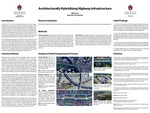
Hybridized-Highway Infrastructures
Will Sutton
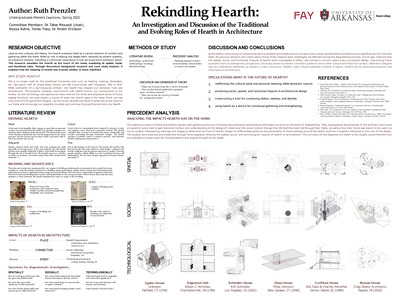
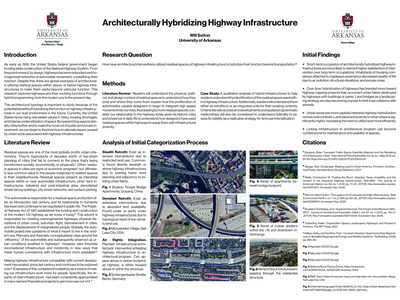
This research explores highways and their evolving functions through hybrid programming, from the modern era to the present day. As early as 1916, the federal government began funding state construction of the National Highway System. From this point onward, by design, highways became redundant and homogenized networks of automobile movement, crystallizing their function. Despite this, there are global examples of architecturally utilizing space within, above, or below highway infrastructures that hybridize their function beyond vehicular movement. I am currently studying hybridized-highway infrastructures through a literature review that examines them through the lenses of underutilized space associated with highways, the roles of highways over time, and 20th-century urban planning practices. The literature review further categorizes these hybrid-highway infrastructures, explains what hybridized-highway infrastructures are and where they exist, and draws connections between them. The objective of this study is to highlight idiosyncratic forms of infrastructure-architecture developments that have been speculated to meet the needs of people in urban environments. By embedding hybridized-highway infrastructures in the context of the 20th century, this research aims to reveal historical narratives typically not discussed. Additionally, this study examines how these narratives of architectural and social intervention in highways could be translated into the 21st century. My preliminary research suggest hybrid services in our built environments are more resilient to change and provide more use to people who are most proximately impacted by these services. Investigating hybridized-highway infrastructures will therefore explore if issues in contemporary American life, including cost-of-living concerns, the costs of land development, and continued urban sprawl, can be alleviated by radically reshaping our ideas of how our infrastructure serves us.
-
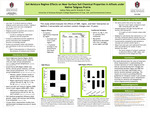
Soil Moisture Regime Effects on Near-surface Soil Chemical Properties in Alfisols under Native Tallgrass Prairie in Arkansas
Sydney Talley
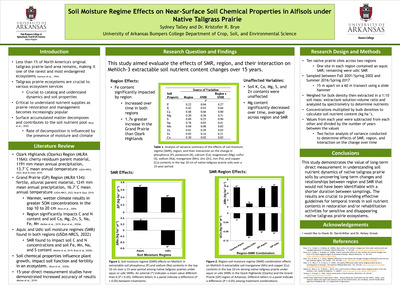
Tallgrass prairie ecosystems provide many crucial ecosystem services, including nutrient cycling and storage, organism habitat, and soil and water conservation. However, tallgrass prairies are considered endangered ecosystems, particularly in the Ozark Highlands and Grand Prairie regions of Arkansas, where less than 0.05% of the state's original prairie land area remains. Understanding soil nutrient supplies over time in native tallgrass prairie ecosystems is critical for quantifying the success of restoration and rehabilitation activities. The objective of this study was to evaluate the effects of soil moisture regime (SMR) (i.e., aquic and udic), region (i.e., Ozark Highlands and Grand Prairie), and their interaction on the change in soil nutrient contents (i.e., P, K, Ca, Mg, S, Na, Fe, Mn, Zn, and Cu) in the top 10 cm over 15 years (i.e., 2001/2002 to 2016/2017). Soil samples were collected from the top 10 cm of the soil across 10 sites in both 2001/2002 and 2016/2017. Soil nutrient content changes over time were quantified. Averaged across SMR, extractable soil Fe content increased over time in both regions. Averaged across region, both soil extractable P and Na contents were impacted by SMR, where soil P content increased in both SMRs over time, while soil Na content did not change over time in the aquic, but decreased over time in the udic SMR. Soil Mn content increased over time across all region-SMR combinations, except for the Ozark-udic combination, which did not change over time. Soil Cu content decreased in all region-SMR combinations, except for the Ozarks-aquic combination, which did not change over time. The results of this study demonstrate the value of direct measurements over time for accurate assessment of temporal changes in soil nutrient contents. This study can be used to gauge success and set expectations of the potential effects of physiographic region and soil moisture regime on restoration efforts in native tallgrass prairies in the mid-Southern United States.
-
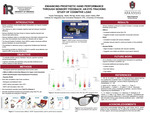
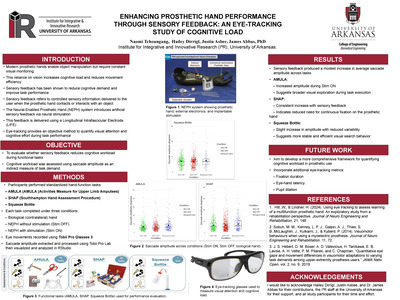
Monitoring Eye Movements to Assess the impact of Sensory Feedback on Cognitive Workload During Myoelectric Prosthetic Hand Use
Naomi Tchoungang, Hailey Dirrigl, and Justin Asbee
Modern prosthetic hands allow users to grasp and manipulate objects, but many users must constantly watch the device to complete even simple tasks. This heavy reliance on vision increases cognitive effort, slows movement, and makes prosthetic use feel less natural. An important question in prosthetics research is whether providing sensory feedback (enabling users to feel what the prosthetic hand is doing) can reduce this cognitive load and improve performance. In this study, sensory feedback refers to a system that provides clear tactile cues to the user upon contact between the prosthetic hand and an object, helping replace information normally felt through the natural hand. This study examines how sensory feedback influences cognitive workload during everyday hand use by analyzing eye movement behavior. Eye movements provide an objective and intuitive way to measure how much visual attention a person requires while completing a task. When tasks become easier and more intuitive, individuals tend to spend less time visually monitoring the hand and are able to visually explore other areas of the task space more efficiently. Methods:Participants complete standardized hand-function assessments, including the Southampton Hand Assessment Procedure (SHAP) and the Activities of Myoelectric Upper Limb Assessment (AMULA). These tasks are designed to reflect common daily activities such as grasping, lifting, positioning, and manipulating objects of varying sizes and shapes. Tasks are performed under three conditions: using the intact (non-amputated) hand, using a myoelectric prosthetic hand without sensory feedback, and using the same prosthetic hand with sensory feedback. Eye-tracking data are collected using Tobii Glasses 3 and analyzed in Tobii Pro Lab, where areas of interest, including the task objects and the hand, are defined to quantify visual attention patterns such as gaze duration, gaze shifts, and eye–hand coordination. Data are processed to remove recording artifacts and are visualized using plots and visual maps of gaze behavior to enable direct comparison across conditions. Results:It is expected that the presence of sensory feedback will reduce reliance on visual monitoring. This reduction is anticipated to appear as shorter and fewer visual fixations, faster coordination between visual attention and hand movement, and more efficient overall eye movement patterns. Performance with sensory feedback is expected to more closely resemble behavior observed when participants use their intact hand. The results of this research may help guide the design of future prosthetic devices by demonstrating how sensory feedback can reduce cognitive workload and improve functional usability. Ultimately, this work aims to support the development of prosthetic hands that are easier to learn, more intuitive to use, and better suited for everyday life.
-
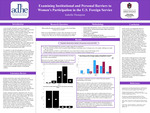
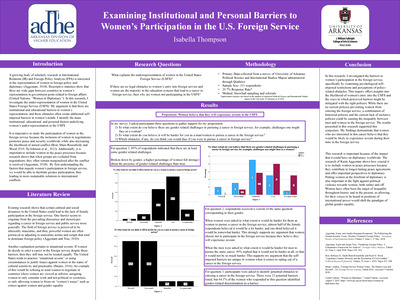
Examining Institutional and Personal Barriers to Women's Participation in the U.S. Foreign Service
Isabella Thompson
Gender equality and equal representation for women have become heavily debated topics in the global community over the last few decades. Some countries have constitutional policies in place that promote gender equality, while others have extreme gaps between the rights of men and women. One area commonly used to assess how far a country has progressed toward gender equality is women’s representation in government and politics. A growing body of scholarly research in International Relations and Foreign Policy Analysis examines the representation of women in foreign policy and diplomacy. Descriptive statistics show wide gaps between countries in women’s representation in government posts related to foreign affairs. In Scandinavian countries such as Sweden and Norway, women make up approximately 50% of ambassadors. Compared to these countries, the United States of America lags behind - women only make up about 34% of the ambassadors. The United States has had over 4,600 ambassadors since the State Department started sending diplomats abroad in 1893. Of these 4,600 representatives of the United States, only 9% of them have been women. This under-representation of women goes directly against the United States Foreign Service Act of 1980, which claims that the foreign service needs to be “truly representative of the American people throughout all levels.” At the same time, women constitute the majority in such fields as political science and international relations, which often lead to a career in foreign service. It is puzzling, therefore, why women continue to be underrepresented in foreign service posts. If women are the majority in the education systems that lead to a career in foreign service and there are no blatant policy barriers to women participating in the foreign service, then why are they not participating? In my research, I combine methods in policy analysis and political psychology to analyze the institutional and personal barriers obstructing women from participating in the foreign service. I have collected data from literature reviews, foreign policy analyses, and an original survey to support my four propositions: women feel as though they will experience sexism in the foreign service, women feel as though the foreign service does not promote work-life balance, women do not feel as though there are role models within the foreign service, and women do not feel as though they would be supported in the foreign service. My goal with this research is to have a better understanding of why there are gender disparities in the United States Foreign Service and what other countries are doing to combat this.
-
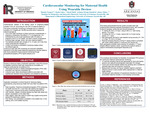
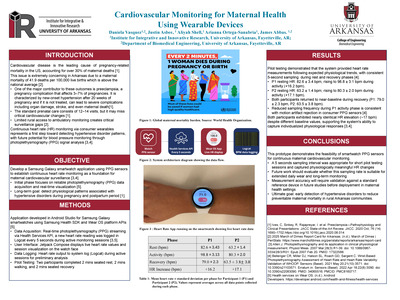
Cardiovascular Monitoring for Maternal Health Using Wearable Devices
Daniela Alejandra Vasquez
Cardiovascular disease represents the leading cause of pregnancy-related mortality in the United States, accounting for over 30% of maternal deaths, with preeclampsia and hypertensive disorders contributing significantly to this burden. In Arkansas, maternal mortality rates reach 41.9 deaths per 100,000 live births. Current prenatal care relies on intermittent office-based blood pressure measurements conducted during 12-14 clinical visits, may not capture critical cardiovascular changes in a timely manner. Preeclampsia is characterized by new-onset hypertension after 20 weeks of gestation, affects 3-7% of pregnancies, and requires early detection to enable timely intervention. The limited accessibility of ambulatory blood pressure monitoring in rural settings, combined with barriers to frequent in-person postpartum follow-up, creates critical gaps in cardiovascular conditions that contribute to preventable maternal morbidity and mortality.Research Objective: This project aims to develop an algorithm that uses photoplethysmography (PPG) sensors embedded in smartwatches to provide continuous heart rate monitoring for pregnant individuals. The primary objective is to create an accessible, user-friendly cardiovascular monitoring system capable of detecting physiological patterns that may indicate the development of hypertensive disorders or cardiovascular complications during pregnancy and the postpartum period. This work represents the initial development phase, focusing on establishing core functionality for PPG data acquisition and real-time heart rate visualization through integration with wearable consumer technology.Methods: The application is being developed to integrate PPG sensor data from Samsung Galaxy smartwatches using the Samsung Health SDK and Wear OS platform APIs. Initial development efforts focus on establishing reliable data acquisition protocols. The system architecture is being designed to support the future implementation of machine learning algorithms. The current development phase focuses on creating an intuitive user interface that displays real-time heart rate data, provides basic trend visualization, and supports data logging. Expected Outcomes: This preliminary development work is expected to yield a functional prototype application capable of acquiring and displaying continuous heart rate data from Samsung smartwatch PPG sensors. Successful completion of this initial phase will demonstrate the technical feasibility of integrating consumer wearable technology for maternal cardiovascular monitoring and establish the foundation for future enhancement with predictive analytics capabilities. The prototype is anticipated to provide proof-of-concept for continuous monitoring that extends beyond traditional office-based assessment intervals. Future development iterations will incorporate gestational-age-specific reference algorithms and alert systems for values exceeding personalized thresholds, with the ultimate goal of enabling early detection of cardiovascular complications and facilitating timely clinical intervention. Implications: This project addresses critical gaps in maternal cardiovascular surveillance by developing an accessible monitoring solution that leverages existing consumer wearable technology. Successful development of this application has the potential to reduce barriers to continuous physiological monitoring, particularly for pregnant individuals in rural communities where frequent clinical visits present significant logistical challenges.
-
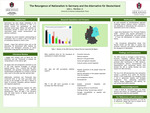
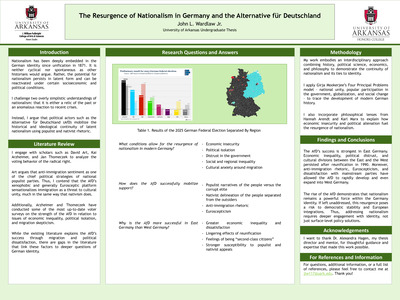
Understanding the Reemergence of Right-Wing Extremism in Germany
John Wardlaw
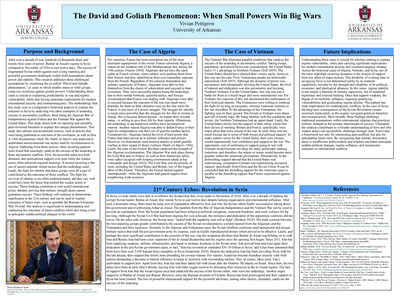
My thesis examines the growing popularity of the Alternative für Deutschland (AfD), Germany’s leading radical-right-positioned party, in the context of broader ideological shifts in post-war Europe. The AfD’s rise reflects a shift from the cosmopolitan ideals that dominated the mid- to late-twentieth-century Europe toward a resurgence in national populism, reminiscent of the late-nineteenth-century political currents that shaped pre-war Europe. To analyze this phenomenon, I turn to Dr. Girija Mookerjee’s four-principle problems framework: the problem of national unity, the extent of popular participation, state participation in a global setting, and the socioeconomic problems found alongside industrialization. While Dr. Mookerjee’s work was conducted in the mid-twentieth century, his principal framework remains relevant today. With this framework in mind, Germany’s rightward political shift may be best understood as the culmination of external pressures, such as post-war supranational institutions, compounded with an internal philosophical inquiry over what it means to be German. Additionally, I argue that the AfD exploits the nuanced relationship between German identity and international relations through deliberate rhetoric and actions to polarize voters and undermine the democratic idealism of Germany’s Basic Law (Grundgesetz). My interest in the Alternative für Deutschland rests on the exponential growth it has experienced both in popularity and influence in the last election cycle, represented by the seats it has won in provincial parliamentary elections. As national populism takes root in the Eastern German states (former DDR-states), further radicalization in both economic theory and Euroscepticism is liable to sweep through the country. If this rightward shift is left without remedy, the threat of adverse German isolationism, including but not limited to the departure from the European Union (EU), becomes further salient.
-
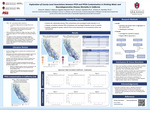
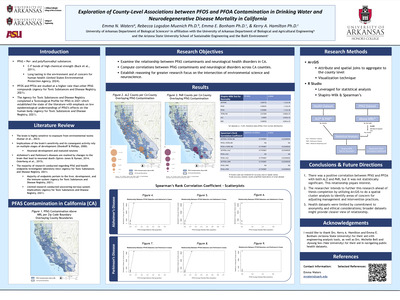
Analysis of the pervasiveness of per- and polyfluoroalkyl substances (PFAS) and their relationship with the incidence of neurological health disorders
Emma Waters
Per- and polyfluoroalkyl substances (PFAS) are a contaminant of emerging concern due to their chemical structure that afford a plethora of issues with regards to degradation on environmental and metabolic fronts. PFAS are amphiphilic and contain a carbon-fluorine bond, which complicates their movement through the environment and ensures their longevity in biological systems. Their persistence in biological systems has led them to be marked as “forever chemicals” and have emphasized them as a priority area for research in recent years. Current work on PFAS relationships to human health have pointed to some causes for concern. Much of the research on PFAS and human health does not focus on neurological health. With animal studies, primarily mice models, establishing relationships between PFAS and nervous system effects, more work is needed to understand potential exposure pathways for mitigation. Therefore, the goal of this research is to complete an exploratory analysis of the relationship between PFAS compounds in drinking water and the incidence of neurological health disorders that are listed as a cause of death for populations in the United States. Data on PFAS compounds was collected from the U.S. Environmental Protection Agency and compared with county-level health outcomes for two states in the U.S. using ArcGIS and R. The outcomes of this research have the potential to provide justification for future studies aimed at evaluating environmentally-based PFAS exposures and human health.
-
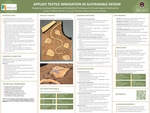
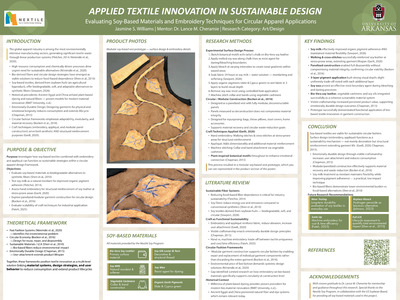
Applied Textile Innovation in Sustainable Design: Evaluating Soy-Based Materials and Embroidery Techniques for Circular Apparel Applications
Jasmine Williams
Applied Textile Innovation in Sustainable Design:Evaluating Soy-Based Materials and Embroidery Techniques for Circular Apparel Applications AbstractThe global apparel industry is recognized as one of the most environmentally intensive manufacturing sectors, driven by high resource consumption, chemically intensive processing, and linear production systems that generate significant textile waste. In response to these challenges, sustainable fashion research increasingly emphasizes the exploration of bio-based materials and circular design strategies that reduce environmental impact while maintaining functional and aesthetic value. This applied design research project investigates the potential of soy-based textiles combined with embroidery and applique techniques as sustainable strategies for circular apparel applications.Grounded in sustainability and circular fashion scholarship, the project draws on historical and contemporary precedents that highlight the use of plant-derived fibers and craft-based techniques as durable and functional components of textile production. Soy-based textiles, derived from agricultural byproducts of soybean processing, present an opportunity to support waste reduction and renewable material systems while remaining adaptable to experimental apparel design. This study specifically examines how soy-based materials perform in surface design and construction when paired with traditional textile techniques such as resist dyeing and embroidery.The project was conducted as a hands-on experimental design process resulting in a panelized vest prototype. All soy-based materials—including soy leather, soy silk, soy wax, and soy milk—were provided by the United Soybean Board. The garment was intentionally designed using modular panels to align with circular design principles, allowing components to be disassembled, repaired, or repurposed into alternative products. Surface design experimentation involved wax resist techniques, bleaching, and repeated applications of soy milk and organic pigments to evaluate pigment adhesion, material flexibility, and visual depth. Hand embroidery using walking and cross-stitch techniques was applied to reinforce stress-prone areas while introducing plant-inspired motifs that emphasized visible craftsmanship. Final construction incorporated limited machine stitching to balance handcraft with scalability considerations.Results from the design process indicate that soy-based materials are well suited to experimental apparel applications. Soy milk treatments functioned effectively as both a mordant and softening agent, improving pigment adherence while maintaining flexibility. Repeated pigment applications enhanced visual richness, though minor reductions in uniformity highlighted tradeoffs between consistency and aesthetic complexity. Embroidery significantly reinforced areas of mechanical stress, supporting research that positions surface reinforcement as a strategy for extending garment lifespan. Panelized construction proved effective in supporting modularity and circularity without compromising material integrity.This project demonstrates that combining bio-derived soy-based materials with embroidery and applique techniques can enhance both durability and aesthetic engagement within circular apparel design. By framing surface design as a functional sustainability strategy rather than a purely decorative element, the study contributes to applied textile research and sustainable design pedagogy. While limited in scale, the findings suggest opportunities for further research through wear testing, lifecycle assessment, and comparative analysis across additional bio-based fibers to evaluate long-term performance and scalability.
-
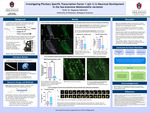
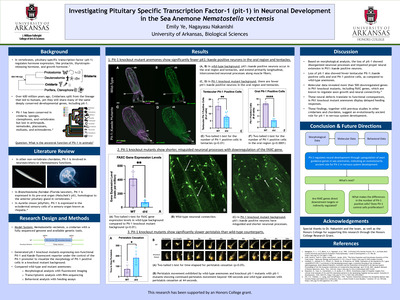
Investigating Pituitary Specific Transcription Factor-1 (pit-1) in Neuronal Development in the Sea Anemone Cnidarian Nematostella vectensis
Emily Ye
In bilaterians — animals with bilateral symmetry, like vertebrates and insects — the pituitary specific transcription factor-1 (pit-1) is essential for regulating growth hormone and prolactin expression in the pituitary gland. However, in non-bilaterians, the ancestral function of pit-1 remains unknown. Cnidarians, such as the sea anemone Nematostella vectensis, form a sister group to bilaterians and lack a pituitary gland, making them a powerful model for investigating the early evolutionary role of conserved developmental genes, like pit-1.Using CRISPR-mediated gene editing, pit-1 knockout mutants — anemones without the pit-1 gene — were generated, and their transcriptomic, cellular, and behavioral phenotypes were compared to their wild-type siblings. RNA sequencing revealed significantly downregulated expression of a failed axon connection gene in pit-1 mutants (FAXC), a gene associated with misguided neuron axon connections in bilaterians. These findings were further supported with transgenic fluorescent reporter protein staining, showing fewer pit-1-positive cells in the oral region and misoriented neuronal processes along the body column in knockout animals. The neural defects, consequently, were accompanied by behavioral costs, such that pit-1 mutants exhibited delayed responses during brine shrimp feeding assays and slower cessation of peristaltic movements (i.e. digestive movements) compared to wild-type controls. Together, the results suggest that pit-1 contributes to nervous system formation and neural connectivity in cnidarians. Overall, these findings indicate the possibility that the pit-1 gene may have played an important role in neural development prior to the divergence of Bilateria and Cnidaria. Whether FAXC is a direct downstream target of pit-1 remains a question for future investigation.
Printing is not supported at the primary Gallery Thumbnail page. Please first navigate to a specific Image before printing.