-
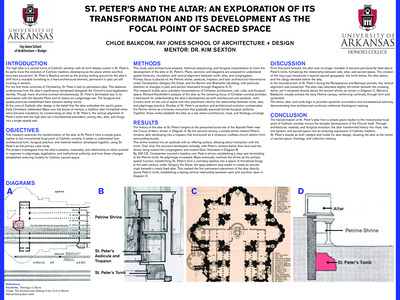
St. Peter’s and the Altar: An Exploration of its Transformation and its Development as the Focal Point of Sacred Space
Chloe Balkcom
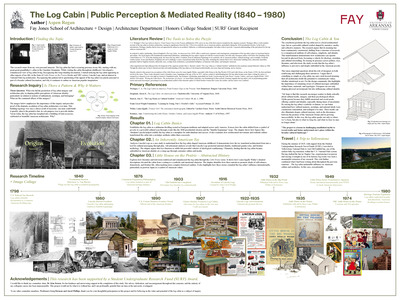
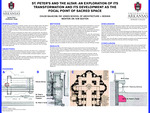
This study explores the evolution of the high altar at St. Peter’s, tracing its history as a ritual focal point within the basilica. Rooted to being the presumed burial site of the Apostle Peter, the basilica served as a primary testing ground for the evolving relationship between altar, relic, and liturgy. Arguably, the altar's gradual formulation in its position from a movable object to a fixed structure, mirrors the actual Church’s broader effort to find its identity, authority, and ritual practice following the legalization of Christianity. Through architectural, material, and liturgical analysis across the centuries, the paper examines spatial consequences of key interventions and reveals the ways in which architectural form has been employed to reinforce continuity, hierarchy, and theological meaning throughout years of reconstruction. By situating the altar within an unbroken religious tradition, this paper positions St. Peter’s as both a catalyst and model for Catholic altar design. Ultimately, it argues that the altar at St. Peter’s transformed history into liturgy, material into symbol, and sacred space into an enduring expression of the Catholic tradition.
-
Resilient Communities: Affordable Solutions to Extreme Heat
Rylee Ball
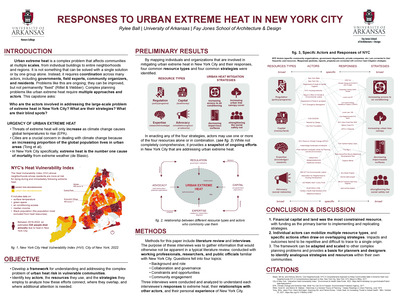
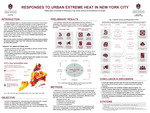
Climate change is wicked. The term itself lacks a single definition and individuals vary in understanding of its causes and effects. Often, it is considered through the lens of global phenomena: deterioration of the ozone layer, destabilization of the arctic circle, or other abstract impacts that are often difficult to fully comprehend. Harder to trace is the impact on a local scale: access to food and water, increase in natural disasters and displacement. The impacts threaten to deepen already wide inequalities. Design theorists Horst Rittel and Melvin Webber characterized such challenges as “wicked problems,” a concept that aptly describes climate change. Wicked problems are defined by their complexity, evolving conditions, and lack of definitive solutions; responses are neither right nor wrong, but rather better or worse. Despite the impossibility of a final or singular solution, engaging with wicked problems remains essential, as incremental and context-specific interventions can produce meaningful impacts. This urgency is especially pronounced in low-income communities, where limited access to financial resources, infrastructure investment, and political capital significantly reduce climate resilience. In the face of extreme heat and other climate-related stressors, recovery times in these communities are often substantially longer than those of their more affluent neighborhoods. This disparity raises a critical question: how can vulnerable communities build resilience using the resources available to them? This capstone investigates how small-scale, accessible design interventions can mitigate extreme heat in economically and socially vulnerable urban communities. It examines how these interventions are conceived, implemented, and maintained, the role of community participation in their development, and their potential to serve as scalable models for equitable climate adaptation.
-

The Seedling
Caden Bent
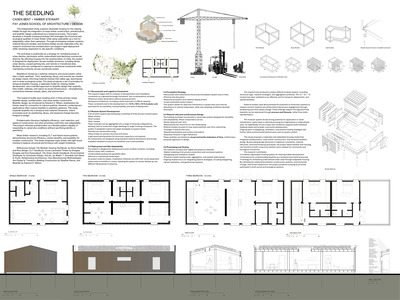
This research investigates attainable housing for the missing middle through the integration of mass timber construction, prefabrication, and biophilic design. The project proposes a modular housing system that leverages the structural efficiency, quality control, and ecological performance of mass timber while emphasizing replicability as a means of adaptability rather than uniformity. Through prototyping modular systems, material life cycle studies, and iterative design across replicable and adaptable units, the study examines how prefabrication can accelerate construction timelines without erasing local, cultural, or temporal specificity. Central to the research is an expanded understanding of biophilia, not as applied aesthetic, but as a material and social system shaped by time. Weathering, decay, renewal, and seasonal change are treated as design inputs, informing the selection of materials that visibly age, decompose, and re-enter ecology life cycles. These processes are used to articulate reciprocal living, where housing participates in the ongoing exchanges between human habitation, community continuance, and environmental systems. The prototype is positioned as a strategy for revitalizing areas of urban decline, particularly within underutilized and declining commercial districts. By stitching housing into the existing fabric of cities, the system is designed for deployment across multiple scenarios, including dense urban blocks, unused parking lots, and remote or transitional sites. Modular units are configured to respond to situational constraints while maintaining continuity across community scales. The outcomes of this study include a set of principles for temporal biophilic housing, a replicable and adaptable model for missing middle development, and a clarified framework for biophilic design that moves beyond abstraction. By making explicit connections between health, wellness, material cycles, and social structure, the project positions housing as an active agent in strengthening both community relationships and environmental awareness.
-
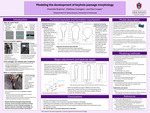
Modeling the Development of Keyhole Passage Morphology
Charlotte Boehme
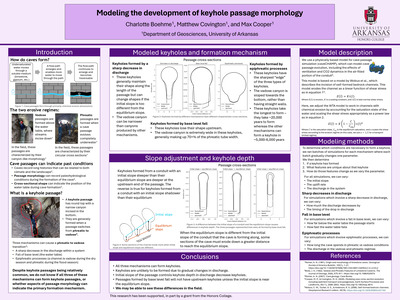
Cave passage morphology is an important indicator of the hydrological conditions under which a cave passage was formed. Keyhole passages are a commonly occurring type of passage morphology that consists of a round, wide top with a smaller canyon incised in the bottom of the passage. These passages typically indicate a shift from fully water-filled to partially water-filled conditions. There are multiple mechanisms by which such a transition can occur, and little is understood about which of these mechanisms is most common, or whether aspects of keyhole passage morphology may indicate the primary formation mechanism. CaveCHAMP is a physically based cave evolution model that can simulate the evolution of passage shape along an extended conduit, including effects of ventilation and CO2 dynamics in the air-filled portion of the cave. We have found several ways to model keyhole passage formation using CaveCHAMP, including manipulating discharge and chemistry. To quantify changes in cross section shape, we have developed a set of parameters to describe the shape of the cross section. These parameters quantify several key characteristics of a keyhole-shaped cross section, including the relationship between the widths of several parts of the passage. We have simulated the changes to keyhole morphology along a conduit and shown that the cross section maintains its geometry throughout the passage when created by a sudden decrease in discharge. In contrast, the keyhole widens and becomes less distinct upstream when created by base-level fall. We have also discovered that the distinctiveness of a keyhole shape is controlled by the timescale during which the transition from water-filled to partially water-filled occurs. These differences in morphology indicate that field observations of keyholes may allow us to constrain the conditions under which they formed. Utilizing cave passage morphology could be key in understanding past hydrologic conditions in areas where traditional hydrological indicators are absent.
-
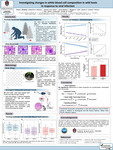
Investigating changes in white blood cell composition in wild hosts in response to viral infection
Anna Bolding
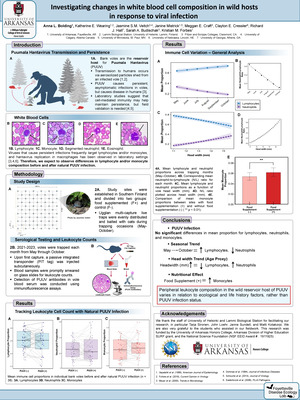
Reservoir hosts play a critical role in the persistence and spillover of zoonotic pathogens. Upon infection, reservoir hosts can shed viral loads sufficient for transmission and spillover often without displaying apparent pathogenic effects. Investigating how their immune systems control infection can provide insights into the factors that facilitate spillover events. Understanding the mechanisms that enable these infection characteristics is crucial for informing public health and conservation strategies. Though reservoir hosts’ immune responses are well-documented in controlled laboratory settings, these studies are not representative of natural populations. The bank vole - Puumala hantavirus (PUUV) system is well suited for investigating such host-pathogen interactions in wild populations. By examining how PUUV influences immune responses in wild bank voles, we may gain a better understanding of the mechanisms that allow for viral persistence in reservoir hosts. Using a capture-mark-recapture approach, natural populations of bank voles were longitudinally monitored at monthly intervals over three years. Over 2000 paired samples were collected to determine hantavirus infection status and immune profiles. Using differential white blood cell counts, we evaluated changes in immunity for individual voles before and after PUUV infection. Immune profiles of individuals who seroconverted from PUUV-negative to PUUV-positive showed no significant differences in monocytes, lymphocytes, and neutrophils before and after infection. Furthermore, PUUV infection showed no association with leukocyte profiles, whereas variation in leukocyte profiles was significantly associated with vole characteristics and environmental factors. This investigation aims to provide insights into PUUV-associated immune responses within wild populations of the reservoir host. Ultimately, these results enhance our understanding of immune responses in wildlife, contributing to better management practices for hosts of zoonotic infectious diseases.
-
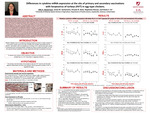
Differences in cytokine mRNA expression at the site of primary and secondary vaccinations with herpesvirus of turkeys (HVT) in egg-type chickens.
Allie Bowerman
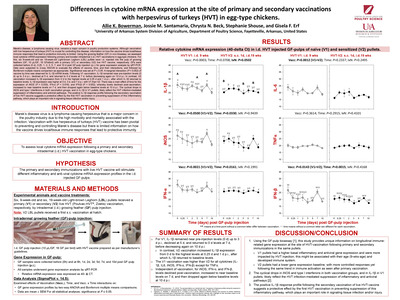
Marek’s disease, a lymphoma causing virus, remains a major concern in poultry production systems. Although vaccination with live herpesvirus of turkeys (HVT) is crucial for controlling this disease, information on how the vaccine drives local/tissue immune responses that lead to protective immunity is limited. Using the growing feather (GF) in vivo bioassay, we assessed local cytokine mRNA expression following primary and booster intradermal (i.d.) HVT vaccinations in egg-type chickens. For this, six 9-week-old and six 19-week-old Light-brown Leghorn (LBL) pullets were i.d. injected into the pulp of growing feathers (GF; 10 µL/GF; 16 GFs/bird) with a primary (V1) or secondary (V2) live HVT vaccine, respectively. GFs were collected before (0 d), 0.25, 1, 2, 3, 5, 7, and 10 d post GF-pulp injection (p.i.) for gene expression analysis by qRT-PCR. Data were subjected to 2-way ANOVA to evaluate the effects of vaccine, time, and their interactions, and followed by Bonferroni multiple means comparison as appropriate. Significance was set at P0.05. A marginal interaction (P = 0.052) of vaccine by time was observed for IL-1β mRNA levels. Following V1 vaccination, IL-1β remained near pre-injection levels (0 d) up to 3 d p.i., declined at 5 d, and returned to 0 d levels at 7 d, before decreasing again on 10 d p.i. In contrast, V2 vaccination increased IL-1β expression from 0 d to the highest levels at 0.25 d and 1 d p.i., after which IL-1β returned to baseline levels. IL-1β expression was higher at 0 d, 3 d, and 7 d p.i. with V1 than V2. There was a main effect of time for the expression of iNOS (P = 0.033), IFN-α (P = 0.016), and IFN-β (P = 0.002), whereby levels declined post-vaccination, increased to near baseline levels on 7 d, and then dropped again below baseline levels at 10 d p.i. The cyclical drops in iNOS and type I interferons in both vaccination groups, and in IL-1β in V1 pullets, likely reflect the HVT infection-mediated suppression of inflammatory and antiviral pathways. The positive IL-1β response profile following the secondary vaccination of live HVT-vaccine suggests a protective effect by the first HVT vaccination in preventing suppression of this inflammatory pathway, which plays an important role in signaling tissue infection and/or injury.
-

“The Influence of Social Media and Algorithmic Capitalism on Popular Fiction”
Emma Bracken
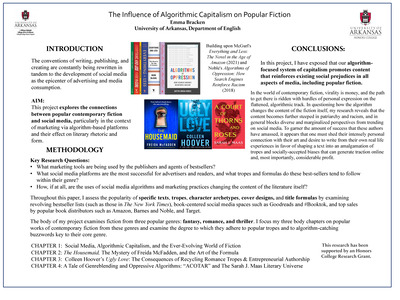
In giving over literature wholly to the market, collapsing as far as possible the distance between literature’s residually sacral significance as a repository of higher values and its everyday function as a commodity, Amazon in one sense intensifies a phenomenon occasioned by the consolidation of publishing in recent decades into immense multinational media conglomerates,” writes professor Mark McGurl in his book, Everything and Less: The Novel in the Age of Amazon (2021). McGurl’s research on Amazon’s role in the literary industry created a baseline for my research on the use of algorithms in digital marketplaces as they relate to literary sales, particularly in trending fiction titles. My research on algorithms exposes a greater link between popular fiction and social media algorithms, as the digital age changes the fundamentals of storytelling, authorship, and distribution of media. My paper will explore shifts in design, content, and marketing of popular contemporary fiction novels as a result of the literature industry’s increasing reliance upon social media and digital marketplace algorithms. Further, I will draw into question how algorithms and social media use have changed what the novel represents to readers, writers, and corporations. In three chapters I analyze a best-selling text from three of the most popular fiction genres: thriller, romance, and fantasy. The novels I focused my analysis on were Freida McFadden’s The Housemaid (2022), Colleen Hoover’s Ugly Love (2014), and Sarah J. Maas’s A Court of Thorns and Roses (2015). Through these popular texts and others in each genre I have discovered trends across the genres in tropes, character archetypes, and title and cover design, increasing in homogeneity as the industry further relies on social media for marketing and distribution of popular texts. This research is my first project in a continued academic interest in contemporary literature’s relationship to developments in digital media, and my aim to increase consciousness among readers, social media users, and shoppers about what they are consuming, how it reached them, and what, above all, its purpose is.
-
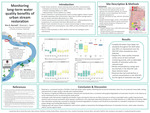
Monitoring long-term water quality benefits of urban stream restoration
Kira Burnett
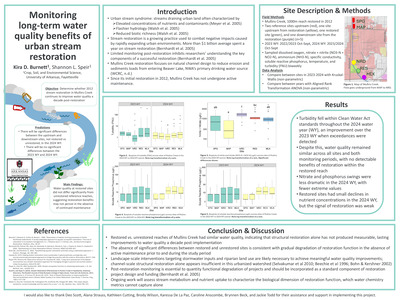
Urbanization without conscious environmental planning can result in the degradation of stream ecosystems. This tends to result in urban stream syndrome, which is often characterized by increased sediment and nutrient concentrations, decreased biodiversity, more frequent flash flooding, and overall water quality degradation. As such, stream restoration practices are often implemented to address urban stream syndrome. Commonly used restoration practices include applying natural channel design to stabilize eroding stream banks and establishing diverse streamside vegetation to filter pollutant inputs. However, the benefits of restoration are not often quantified due to a lack of post-restoration monitoring, making it challenging to determine what restoration success looks like. Therefore, we monitored Mullins Creek, a partially restored urban stream in Fayetteville, Arkansas, for physical and chemical parameters. We sampled five sites in the watershed - two sites upstream of the unrestored reach, one site within the restored reach, and two downstream sites - for dissolved oxygen, nutrients including nitrate + nitrite (NO3-N + NO2-N), ammonium (NH3-N), and soluble reactive phosphorus, specific conductivity, temperature, and turbidity from 2023-2024. Importantly, there has been no active maintenance of the restoration since its establishment. Ten years post-restoration, we found that all parameters met Clean Water Act standards in 2024, including turbidity which exceeded limits in 2023. We did document substantial variation in nutrient concentrations between years, with phosphorus and nitrate showing fewer extreme values in 2024 compared to 2023. The year-to-year variability indicates that the restoration may no longer be resilient and able to maintain water quality under typical year-to-year hydrologic variation. This variation in water quality in Mullins Creek suggests that initial restoration benefits may degrade without continued management, highlighting the need for adaptive maintenance strategies to sustain water quality improvements in urban streams.
-
Exploring the Lived Experiences of School-based Speech-Language Pathologists Following Implementation of H.R.1 (One Big Beautiful Bill Act)
Jenna Burns
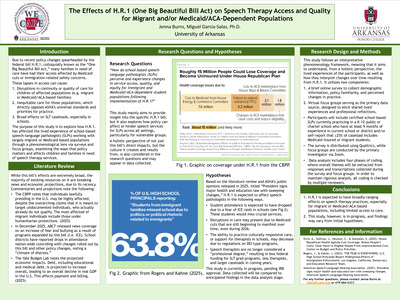
Communication is a human right. As such, ASHA’s official Code of Ethics (2023) states that all speech-language pathologists working under the organization’s credentials have a responsibility to provide equitable and accessible care, regardless of socioeconomic status, citizenship status, or place of origin; however, there can be many barriers to the provision of this service, one of the most prominent being policy. Beginning in 2025, federal policy reforms enacted under H.R.1, colloquially known as the “One Big Beautiful Bill Act,” have impacted health care access, immigration policy, and educational funding, leading to eventual effects on the services of paraprofessionals in publicly-funded school systems. Speech-language pathologists are among the professionals affected, and the role that they play providing care to American families means that they work with diverse populations, many of whom have migrant backgrounds or rely on Medicaid/ACA to receive necessary therapy services. These populations are directly affected by the reforms introduced in H.R.1., and while statements have been released from expert professional organizations such as ASHA regarding the changes, there is limited empirical research on how these policy changes are experienced by frontline school- based providers. This study seeks to employ an interpretative phenomenological approach to explore the lived experience of school-based SLPs following the implementation of H.R.1. An initial survey is used to gather demographic and background information, support purposeful sampling, and obtain a strong foundation of data collection, then followed by virtual focus group-style interviews for a more interpretative, in-depth exploration of the lived experiences of care providers working under this bill. These discussions will primarily investigate perceived changes in access to services, continuity of care, and cultural responsiveness. Transcripts are then analyzed using qualitative analysis to identify patterns shared among care providers working with the populations discussed. Preliminary results are expected to highlight the disruptions in access to Medicaid-basedservices, altered family engagement and culturally responsive practice, and ethical tensions surrounding principles of equity. This investigation aims to contribute expert insights into the effects of policy change on the provision of necessary care services to certain disadvantaged populations and further understand future goals of equitable service delivery in school-based speech-language pathology. The results are anticipated to inform future research, advocacy efforts, and policy discussions. This project is currently in the process of IRB review (#2511634888).
-

"Leafing" through the Chinese Opera: Phytopoetics in The Peony Pavilion
Madison Bussell Escoto
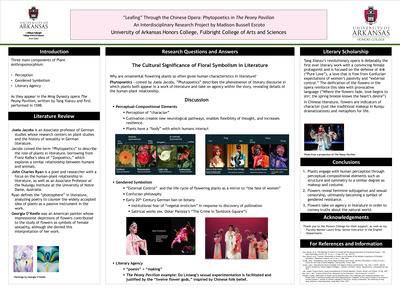
Ornamental flowering plants have been instrumental symbols in literature across all times and cultures. I’m examining why flowers are such perceptual stimulants, sexual symbols, and literary agents. Through the lens of Joela Jacob’s term “phytopoetics,” which describes the impact of plant life on the human imagination and culture; botany; and literary scholarship, I will look closely at this phenomenon in The Peony Pavilion, a Chinese opera from 1598 which features the first recognized complex and convincing female protagonist in world literature. Exploring “the garden” as a place, I will present the embodied, sensory, and relational elements of the human-flower relationship using the striking visual of Tang Xianzu’s revolutionary production. I find that, just as we perceive the costumes and makeup of the opera as giving traits to the characters, we find that the embodied aesthetics of flowers lead us to assign the same conclusive “personalities” to plants. My presentation aspires to make an audience examine their personal relationships with the natural world and consider how extensive the human encounter with flowering plants has been throughout literature, art, and social movements. I hope to eradicate a misconception of flowers in literature: that they’re passive and static, included by authors to be symbolic or even purely decorative. This can be easily disproven by simply taking a closer look at the ever-shifting impact of flowers on the human imagination as their true, dynamic nature can be found in some of the oldest surviving literary and artistic works. The flowers in The Peony Pavilion are more than just a beautiful setting: they are active participants in the narrative and, even more remarkably, proponents of gendered resistance.
-
UAV-Based Sensor Integration for In-Situ Lake Water Quality Monitoring
Alec Campbell
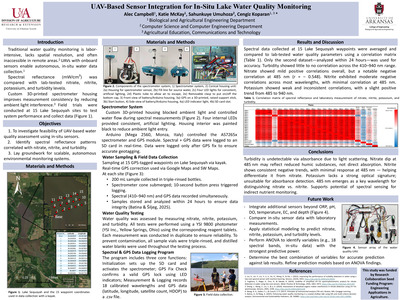
Current water quality assessment methods rely heavily on manual sampling and laboratory analysis, which are time-consuming and difficult to perform in remote or hazardous environments. In surface water monitoring, spatial and temporal resolution is often constrained by labor, access, and logistical limitations of manual sampling programs. This research aims to develop a drone-based system for real-time, in situ lake water quality monitoring. To address these challenges, the project focuses on integrating multiple water quality sensors, including oxidation-reduction potential (ORP), pH, electrical conductivity (EC), turbidity, and a multispectral spectrometer, into a compact, UAV-compatible design capable of collecting spatially referenced data. Methods: A multi-sensor water quality suite was designed and integrated using an Arduino-based data logging system capable of recording synchronized sensor measurements with GPS coordinates. A 3D-printed housing was fabricated for the multispectral spectrometer to minimize ambient light interference and improve measurement consistency. Sensors were programmed, tested, and validated through handheld probe testing and laboratory bench experiments. Future field deployment will involve mounting the sensor array onto a multirotor UAV to collect spatially tagged water quality data over Lake Sequoyah, with laboratory analysis used to validate in situ measurements. Preliminary Results: Preliminary work demonstrated successful integration and stable operation of all sensor modules under controlled conditions. The spectrometer housing reduced stray light exposure and improved repeatability, while synchronized sensor and GPS logging was achieved. Calibration testing identified sensor drift and noise as areas for further refinement prior to field deployment. Although airborne testing has not yet been conducted, bench-scale validation confirms system readiness for UAV integration. Discussion: This research represents a foundational step toward autonomous, UAV-based environmental monitoring systems. By mapping water quality across space rather than relying on single-point sampling, the system provides higher-resolution data capable of revealing gradients and localized anomalies in lake systems. Combining multispectral sensing with physical and chemical probes may enhance detection of nutrient concentrations and support early identification of harmful algal blooms. Overall, this work improves the efficiency, accuracy, and scalability of water resource assessment.
-
Temporal Variational Graph Autoencoder for Influenza Evolution
Soumya Chauhan
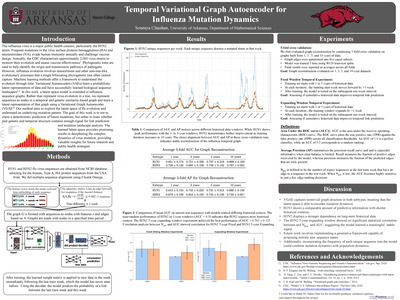
Frequent mutations in influenza virus surface proteins can increase infectivity while evading human and vaccine immunity, causing seasonal epidemics. The CDC annually evaluates thousands of virus strains to predict mutated sequences likely to be dominant in the next season, which creates a need for methods that better capture how viral mutations evolve over time. In this study, we represent influenza protein sequences as a network-like graph, creating connections if sequences are collected a week apart and only differ by one mutation. This method explicitly considers time information as part of the evolution, while other existing methods analyze mutated sequences without time information. We use a machine learning model called a Variational Graph Autoencoder (VGAE) to learn a compact mathematical representation of the flu sequences, and then apply this learned model to new data to determine if the new sequences are close enough for a connection. First, each data point collects information from neighboring sequences to update its own representation, becoming more similar to the sequences near it. Then, the data point is mapped to a range of likely mutations, formally defined as a probability distribution in a lower dimensional space, where the randomness could help us represent the randomness of mutations. To evaluate unseen sequences, the model takes in pairs of new sequences and maps their representation in the lower-dimensional space. Sequences that are more closely related are mapped closer by the learned model, and hence are more likely to be connected to each other. This framework allows us to see how well unseen sequences align with the learned distribution of influenza mutations. When evaluated on the H1N1 strain data, the model achieves an AUC of 0.696 on classifying connections between sequences, which is better than a random guesser with AUC 0.5. Our findings indicate that checking new sequences against the learned distribution can demonstrate relationships between new and old sequences, supporting influenza surveillance and vaccine strain selection.
-
Testing the Effects of Mechanical Stimulation on Mesenchymal Stem Cell Cultures
Ella Collis
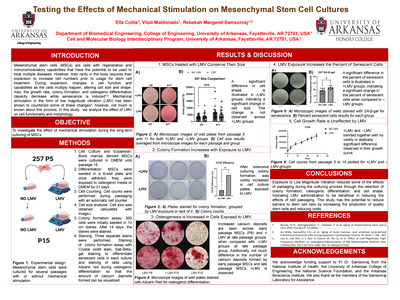
Mesenchymal stem cells (MSCs) are a promising treatment option for a variety of diseases due to their ability to migrate to far-off sites, modulate inflammatory immune responses, secrete factors that aid in tissue healing, and their capacity to become several cell types. These cells can be found and isolated from various body tissues including bone marrow and adipose tissue, even so the number of cells obtained from these tissues is minimal compared to the amounts needed for their transplantation in cell therapy treatments. Therefore, their culture in plastic dishes is required to increase the number of cells and obtain the amount necessary for effective treatments. However, during this process, their quality decreases as they are less capable of becoming other cell types and secreting factors that aid in tissue healing. Moreover, their proliferation time increases, decreasing cell production efficiency. This study aims to investigate the effects of mechanical stimulation during the MSC culture process, hypothesizing that it reverses the changes in cell quality produced by culturing over time. In this study, mechanical stimulation was applied to MSCs daily for the duration of the culture. Then, cell size was measured through microscopic imaging to monitor morphological changes over time. While their ability to proliferate and form colonies was measured through a colony-forming unit assay and by cell counting at multiple timepoints. Additionally, cells were stained with SA-β-gal staining to count the number of cells that became senescent (non-functional), and Alizarin Red staining was used to assess bone differentiation. The results indicate that, with mechanical stimulation, MSCs have an enhanced ability to retain colony formation over time compared to the cells that did not receive mechanical stimulation. Furthermore, the group that did not receive daily mechanical stimulation showed a significant increase in size over time, while the cells treated with mechanical stimulation mostly conserved their size. No difference was observed in the growth rates of the treated and non-treated groups. Differentiation and SA-β-gal staining results will be discussed. The findings of this project could improve efficiency and quality of cell therapy without requiring invasive methods.
-
Professional Wear for Women Aged 30 and Under Post Double Mastectomy Without Reconstruction
Lilly Davis
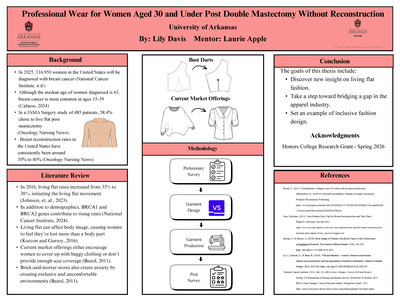
This study explores the fit, functionality, and style preferences of professional wear for women aged 30 and under who have undergone double mastectomy surgery and have not had reconstruction, often referred to as ‘living flat’. While there have been advancements to make adaptive post mastectomy clothing that prioritizes recovery or traditional prosthetic solutions, there still remains a gap in professional wear for younger women that encourages confidence and comfort in the workplace. This research aims to bridge that gap in the apparel industry by providing inclusive, adaptive, and empowering options for the professional setting. A mixed-methods design approach will be used to better understand the personal experiences and preferences regarding professional wear clothing. The research will begin with a pre-survey distributed to women aged 30 and under who are living flat. The survey will collect data on current garment frustrations, desired fits and silhouettes, needs for comfortability, and emotional experiences related to professional wear. Both close ended and open-ended responses will be analyzed to identify recurring themes within the responses. Based on the findings from the pre-survey, two professional wear tops will be designed and constructed. Design decisions including fabric, style, structure, and closures will be decided based on the survey results to reflect participant feedback and prioritize comfort, confidence, and aesthetics. The garments will aim to challenge traditional ideas of femininity in professional fashion while providing versatile and modern options suitable for today’s workplace.Following garment construction participants will be asked to complete a post-survey to analyze the effectiveness of the designs. The survey will assess if the participants would feel comfortable and confident while wearing the garment and to which degree the constructed garments addressed concerns identified in the pre-survey. A comparative analysis will be completed between the pre-survey and post-survey to analyze the successfulness of the garments created. The anticipated outcome of this study includes greater insight into the experience of shopping for professional wear post-mastectomy and the design strategies that can be taken in the future to prioritize inclusivity and adaptability. By centering participants in the design process this research aims to act as an example of what inclusive fashion design looks like and to demonstrate the role apparel plays in confidence, empowerment and belonging in professional environments.
-
Chronostratigraphy Using Stable Carbon Isotopes of the Elliot Formation, South Africa
Aidan del Pino
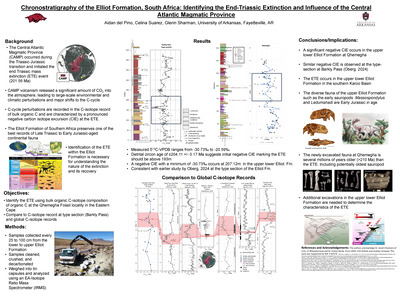
The Elliot Formation in South Africa preserves a fossil-bearing record spanning the Late Triassic–Early Jurassic, a time marked by significant environmental changes related to the Central Atlantic Magmatic Province (CAMP) and the end-Triassic extinction event. Despite its importance, the Elliot Formation remains poorly constrained due to limited chronostratigraphic markers. Chronostratigraphy is the branch of geology that correlates and dates rock units in time, allowing researchers to arrange these rock units into a chronological sequence. Globally, the Triassic–Jurassic boundary is characterized by a pronounced negative carbon isotope excursion linked to CAMP volcanism and the end Triassic extinction event. This C-isotope excursion is dated to 201.56 million years ago and can act as a chronostratigraphic marker for the end Triassic extinction event. This study investigates whether the Elliot Formation records this characteristic carbon isotope excursion at the Qhemegha fossil locality in the Eastern Cape of South Africa. Bulk organic carbon isotope values were measured using isotope ratio mass spectrometry in order to create a high resolution bulk organic carbon isotope profile of the Elliot Formation at the Qhemegha locality. The measured data ranges from -30.73‰ to -20.59‰. A detrital zircon maximum deposition age of 204.11 +/- 0.08 million years ago suggests that the initial negative carbon isotope excursion that marks the end-Triassic extinction should be positioned above 200 meters in the sampled section. The measured negative C-isotope trend reaches a minimum value of -30.73‰ just above this point, suggesting that this measured negative C-isotope excursion may represent the characteristic negative C-isotope excursion marking the end-Triassic extinction. Higher resolution sampling will resolve the origin of the C-isotope excursion at the Qhemegha locality.
-
Development of a Scalable 32x32 Capacitive Sensing Array Using FPGA Controlled Multi-Bus I2C Communication
Jonathan Digby
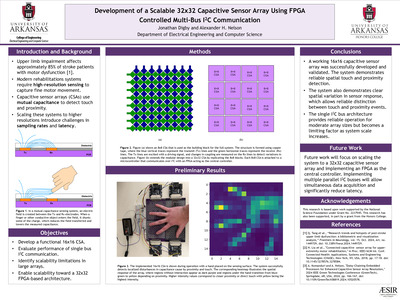
High-resolution capacitive sensor arrays are widely used in applications such as robotics, wearable devices, and biomedical devices where accurate detection of touch, proximity, and motion is crucial. As these systems are scaled up to achieve higher resolutions, challenges pertaining to communication reliability, data synchronization, and system latency become more important. Capacitive sensor arrays detect changes in capacitance caused by disturbances in nearby electric fields. While these arrays are effective at small scales, large arrays often suffer from signal degradation and latency when all sensors rely on a single controller and communication bus. This research addresses these challenges by developing a scalable 32x32 capacitive sensor array that uses multiple microcontrollers controlled by a field programmable gate array (FPGA) through a distributed, multi-bus I2C communication system. To improve scalability, this project distributed sensing across multiple Texas Instruments MSP430 microcontrollers, each responsible for an 8x8 section of the array. Sensor data from these microcontrollers was transmitted using the I2C protocol and collected by an FPGA acting as the system’s master device. Initial testing produced a working 16x16 array using four microcontrollers on a single I2C bus. Building on these results, the FPGA enabled simultaneous data collection from all four buses, which reduced latency and improved scalability compared to traditional single bus designs. Once fully integrated, the 32x32 sensor was calibrated and tested for signal integrity, spatial resolution, and responsiveness. The completed system produced synchronized, high-resolution capacitive data suitable for gesture recognition. The results demonstrate that a distributed, FPGA-controlled architecture can reliably support large-scale capacitive sensing without sacrificing performance. This work contributes a modular and scalable design approach that can be extended to future research in robotics, interactive wearable devices, and FPGA-based signal processing systems requiring high-resolution sensing and low-latency data acquisition.
-
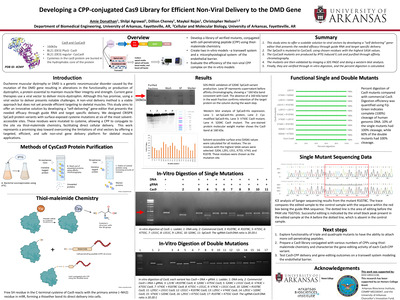
Developing a CPP-conjugated Cas9 Library for Efficient Non-Viral Delivery to the DMD Gene
Amie Donathan
Duchenne muscular dystrophy, or DMD, is a genetic neuromuscular disorder caused by the mutation of the DMD gene, resulting in alterations in the functionality or production of dystrophin, a protein essential to maintain muscle fiber integrity and strength. This mutation leads to progressive muscle degeneration, causing motor loss, cardiopulmonary failure, and ultimately, premature death. Gene therapies using CRISPR aim to replace the mutated gene to provide long-term correction. Although this has promise, CRISPR-based therapies use a viral vector to deliver, which presents notable challenges, such as immune problems and liver toxicity. A non-viral delivery method is a viable approach, but does not yet provide efficient targeting to skeletal muscles. This study aims to offer an innovative solution by developing a “self-delivering” gene-editor that presents the needed efficacy and target-specific delivery. The vector I am using is SpCas9 conjugated to cell-penetrating peptides (CPP) that would allow direct delivery to reframe the DMD gene and prevent many of the unwanted side effects of using a viral vector, such as combating uncontrolled DNA integration and reducing immune responses. We designed modified CRISPR CysSpCas9 proteins with binding sites for cell-penetrating peptides. We first determined we needed binding sites that are surface-exposed and least likely to interfere with the activity of the protein. Using solvent-accessible surface area analysis, we found six sites (S204, V743, K755, R1078, L551, L291) that met these requirements. These six sites were mutated individually (and as 15 dual-mutant permutations) into cysteine, to allow for the CPP conjugation. Leveraging cysteine’s disulfide chemistry, we synthesized CPPs to include a maleimide group that would react with cysteine’s thiol group, creating a stable disulfide bond. Via this chemistry, a CPP will conjugate to a site with a cysteine molecule, facilitating direct cellular delivery. The modified SpCas9 protein variants were overexpressed in E. coli bacterial cultures and purified using Nickel-Sepharose affinity chromatography. We used a precast 7.5% SDS-PAGE gel to confirm successful overexpression and purification by observing a 160kDa SpCas9 band. In vitro digestion (IVD) is a DNA cleavage assay that we used to validate our SpCas9 variants. After running a 2% TAE agarose gel, we would expect to see a DNA band at 913bp and a cleaved band at 791bp. Our IVD data concluded that five of the SpCas9 single variants, except K755C, and all the double variants retained functional cleavage integrity.Our results will demonstrate that non-viral, non-immunogenic deliveries with persistent SpCas9 activity and enhanced tissue specificity are achievable, making this method ideal for gene delivery in skeletal muscles. This strategy could have applications not limited to DMD but also in a wide range of other genetic diseases. Future work would explore the functionality of triple and quadruple mutations to have the ability to attach more than one CPP to SpCas9, forming a library. This work represents a promising step toward overcoming the limitations of viral vectors by offering a targeted, efficient, and safe non-viral gene delivery platform for skeletal muscle applications.
-
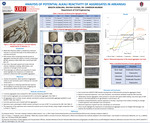
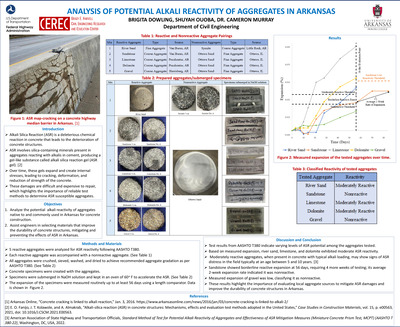
Analysis of Potential Alkali Reactivity of Aggregates in Arkansas
Brigita Dowling
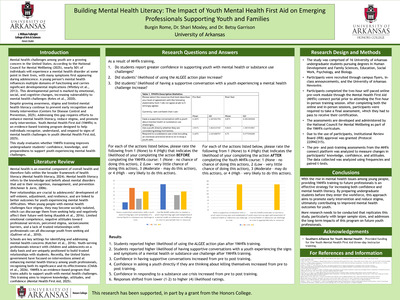
Alkali Silica Reaction (ASR) is a deleterious chemical reaction in concrete that leads to the deterioration of concrete structures. This reaction occurs between minerals present in aggregates and alkalis in the cement, and produces a gel-like substance called alkali silicate gel. Gradually, these gels absorb water from the environment and expand, leading to internal stresses in the concrete. This damage results in expansion, cracking, and deformation, reducing the strength and durability of the concrete significantly. While this damage appears minor initially, eventually they can lead to the need for costly repairs or replacement of the concrete. ASR has been observed in bridges, pavements, dams and other concrete structures in Arkansas and all over the country, stressing the urgency for more investigation into the reactivity of locally sourced aggregates. Aggregate properties vary by region, therefore understanding the behavior of materials specific to Arkansas is essential for improving concrete durability. The purpose of this research is to analyze the potential alkali reactivity of aggregates native to and commonly used in Arkansas for concrete construction. Following AASHTO T380, a standard test used to examine the effects of ASR on miniature concrete prisms, five regional aggregates were tested. Over a fifty-six-day period, the test specimens were exposed to accelerated ASR conditions and were periodically monitored for their expansion and length change. This expansion is analogous to ASR damage. By understanding which aggregates are more prone to ASR damage, the results of this study can assist engineers in selecting materials that improve the durability of concrete structures and ultimately, mitigate and prevent the effects of alkali silica reactivity in Arkansas. The work from this honor’s thesis will be used in conjunction with a broader project to propose more reliable testing regimes to screen aggregates for ASR.
-
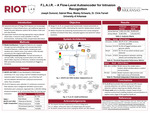
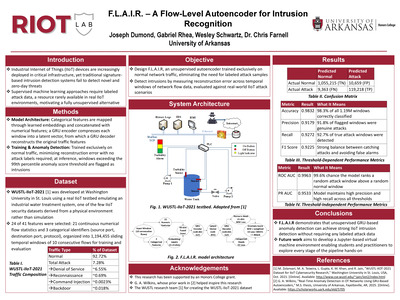
FLAIR- Flow-Level Anomaly Intrustion Recognition
Joseph Dumond
Industrial control systems (ICS) and industrial Internet of Things (IIoT) networks support critical infrastructure such as power generation, water treatment, and manufacturing. As these systems become more connected, they are increasingly exposed to cyber threats. However, many existing intrusion detection approaches rely on detailed packet inspection or supervised machine learning techniques that require labeled attack data and extensive tuning, making them difficult to deploy in real industrial environments.ICS networks typically generate highly regular and predictable communication patterns due to periodic control logic and deterministic device behavior. Because of this structure, abnormal or malicious activity often appears as a disruption to normal communication patterns rather than as a single malicious packet. This observation motivates the need for detection methods that focus on overall communication behavior rather than low-level packet content.This thesis proposes FLAIR (Flow-Level Anomaly Intrusion Recognition), an unsupervised anomaly detection framework designed specifically for ICS networks. FLAIR operates on sequences of network flows, which summarize communication between devices using statistical features such as packet counts, byte counts, transmission rates, and flow durations. By analyzing sequences of flows instead of individual packets, FLAIR captures how communication behavior evolves over time. The proposed approach uses a gated recurrent unit (GRU)–based autoencoder trained only on normal network traffic to learn typical patterns of operation. During deployment, deviations from learned behavior are identified using reconstruction error, which serves as an anomaly score.FLAIR is designed to be evaluated using flow-level data from a publicly available IIoT dataset collected from a realistic industrial testbed. While full experimental evaluation is ongoing, the expected outcome is that FLAIR will be able to distinguish normal traffic from anomalous behavior without requiring labeled attack data during training. This approach is particularly well-suited to industrial environments, where attack data may be limited or unavailable.If successful, FLAIR could provide a practical and scalable intrusion detection solution for real-world ICS networks. By leveraging flow-level data and unsupervised learning, the proposed framework has the potential to improve early detection of cyber threats while remaining compatible with the operational constraints of industrial systems. Additionally, this work may inform future research on sequence-based anomaly detection and contribute to the development of more resilient cybersecurity solutions for critical infrastructure.
-
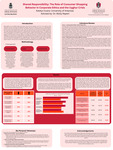
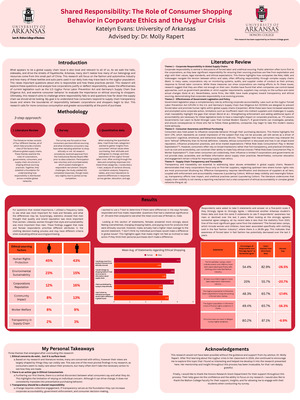
Whose Responsibility Is it: Corporate Ethics and Supply Chain Accountability in the Uyghur Crisis
Katelyn Evans
Global supply chains have become increasingly complex, making it difficult to identify and prevent unethical labor practices embedded within everyday consumer goods. In recent years, attention has been directed toward the use of Uyghur forced labor in China, particularly within the fashion and automotive industries. While governments and corporations have faced growing scrutiny, less is known about how consumers perceive responsibility for unethical sourcing and how unethical practices influence their purchasing behavior. This research seeks to examine the question: Whose responsibility is it to address unethical practices in global supply chains? Specifically, the study evaluates perceptions of responsibility across three key stakeholders, corporations, governments, and consumers, and assesses consumer awareness of Uyghur forced labor and its influence on ethical shopping behavior. A quantitative, survey-based methodology was done using the Qualtrics platform, with approval from the Institutional Review Board (IRB). The survey targeted individuals aged 18 and older and collected data across three primary categories: shopping attitudes and perceptions, awareness of Uyghur forced labor, and ethical values of the consumer. A total of 431 responses were collected. Data was analyzed to identify patterns in consumers attitudes and perceived responsibility across demographic groups, specifically age and gender. Findings indicated that while many consumers express concern about ethical sourcing, levels of awareness regarding Uyghur forced labor remain low. Respondents frequently placed primary responsibility on corporations and governments, while assigning comparatively less responsibility to consumers themselves. These results suggest a gap between ethical concern and ethical action, influenced by awareness, transparency, and access to information.
-
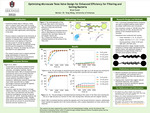
Optimizing Microscale Tesla Valve Design for Enhanced Efficiency for Filtering and Sorting Bacteria
Brian Ewalt
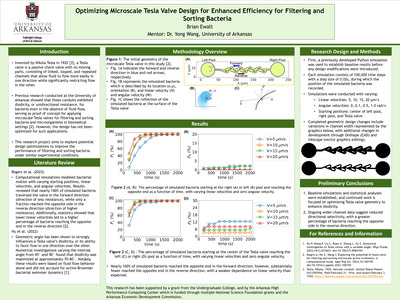
Invented by Nikola Tesla in 1920, a Tesla valve is a passive check valve with no moving parts but showing diodicity for fluids (i.e., allowing fluids to flow easily in one direction but not in the other). Tesla valves have demonstrated remarkable versatility across a range of scientific fields. Recently, a study conducted at the University of Arkansas showed that these conduits exhibited diodicity for bacteria in the absence of fluid flows (Rogers et al. 2023), serving as proof of concept for applying microscale Tesla valves for filtering and sorting bacteria and microorganisms in biomedical settings. However, the design of the microscale Tesla valve has not been optimized for such applications. In this project, I aim to vary the geometric parameters of the microscale Tesla valve and computationally optimize it for filtering and sorting bacteria. To accomplish this, I will perform numerical simulations in Python for bacteria moving in a microscale Tesla value with different geometric parameters. The bacteria will be modeled as active Brownian particles (Volpe et al. 2014) with a broad range of initial positions, linear velocities, angular velocities, and translational and rotational diffusion coefficients. The geometric parameters of the Tesla valve that we will vary include the channel width, number of valve loops, internal valve angle, and end-pool diameters. For each set of parameters, 96 simulations will be run, and the results will be analyzed statistically. The results from this study are expected to provide valuable insights for future work in the fields of biology and applied physics.
-
Romanticizing a Revolution: Jamila, the Algerian
Avery Ferguson
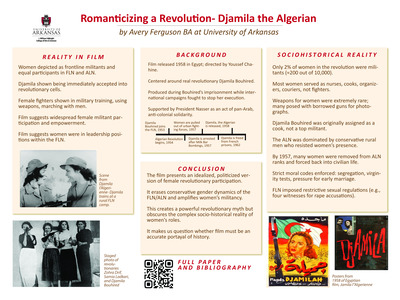
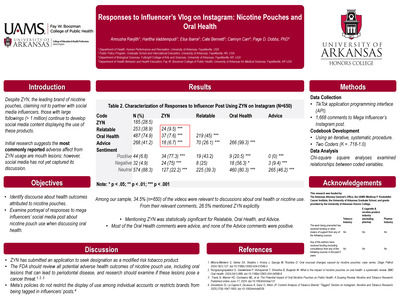
Romanticizing a Revolution Women’s participation in the 1954 Algerian Revolution became a signifier of the revolution itself. One woman- D’jamila Bouhired, became the mother of a movement and icon of the cause. However, D’jamila’s cause, the revolution, was not meant for her, nor the thousands of women who participated and gave their lives to decolonization. In this paper, I will examine the Egyptian film D’jamila, the Algerian, released in 1956. I will examine how film as a medium creates a fictional reality influenced by sociohistorical context yet is not always faithful to it. I argue that D’jamila, the Algerian portrays a differing reality from the sociohistorical context of the revolution as a means of strengthening Pan-Arabism. The reality of the Algerian revolution portrayed in the film shows women as an essential arm of the revolution; they are brutally involved and offer their lives daily. They carry weapons and know how to use them. They sneak bombs in breadbaskets throughout the maze of the city. They shoot men dead in dance clubs while parroting as dancers. They are kidnapped by the French, abused and tortured and raped in prison, then sentenced to death. Women cause an uproar of the entire male Algeria because their woman, Jamila, is prosecuted and murdered. Women are the martyrs that force the revolution. However, based on primary and secondary sources, the sociohistorical context and women’s participation in the revolution was different. Based on the historical reality, women were used to spy on the French, transport secret messages from revolutionary cells to the next. They would carry bombs and ammunition in breadbaskets. However, women were never given military leadership. They stayed in the domestic sphere simply transplanted to a revolutionary context. Women were not permitted to be trained in firing arms at camps- as the film portrays Jamila and her friends doing. The FLN did not support the total freedom of women or abolition of the patriarchy. They utilized the tools they had at their disposal and relied on the patriarchal attitudes of Western Europe to hoodwink the French. It was never an act of feminism, it was the logistics of decolonization. The creation of the film by Egyptian director Youssef Chahine speaks to the dissonance between realities. The film was created in response to the trials of D’jamila Bouhired where the French sentenced her to death. As an attempt to raise support for D’jamila, Egyptian directors, actors, and studios came together. However, the creation of the film was influenced by larger attitudes of Egypt’s push for Pan-Arabism. The film became a tool to garner sympathy and increase support for Algeria’s revolutionary mission. It centered the participation of women in fictional ways in order to mobilize an entire population.
-
P4 Driven Data Plane Analytics for Industrial Control Network Security
Haden Fowler
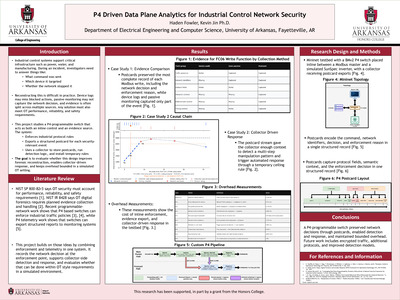
Industrial control systems manage critical infrastructure such as power grids, water treatment plants, and manufacturing facilities. These systems rely on specialized network protocols to send measurements and commands between sensors, controllers, and operator workstations. Protecting these networks from cyberattacks is essential because a successful intrusion could disrupt services that millions of people depend on daily. Most current security monitoring approaches analyze copies of network traffic after it has already passed through the system. This delay means that malicious commands may reach their targets before any alarm is raised. More importantly, when alerts do occur, operators often lack the evidence needed to understand what happened and why, making it difficult to trust warnings or respond effectively.This research develops an evidence-first approach to industrial network security. Rather than simply blocking suspicious traffic, the system treats every policy decision as an opportunity to generate a structured record that proves what the network observed and why a particular action was taken. Using a technology called P4, which allows network switches to be programmed with custom packet processing logic, I built a system that inspects industrial control traffic as it flows through the network. The system examines each packet and generates compact evidence records I call "postcards" that capture four types of context: identity and location information showing where packets came from and where they were going, protocol details extracted from the industrial control messages themselves, timing and performance measurements, and decision information documenting whether packets were allowed or blocked and the specific reason why.The system organizes security capabilities into a tiered structure where each tier addresses a specific category of protection and can be extended as new threats emerge. The first tier covers access control, with current demonstrations including verification of authorized communication patterns. The second tier covers protocol correctness, currently demonstrating message structure and length validation. The third tier covers system availability and transaction integrity, with initial demonstrations including flood prevention and request-response matching. Two additional tiers are currently in development and will address operation-level policy enforcement and semantic validation of transmitted data values. This tiered design provides a repeatable pattern where each layer closes a specific category of security gaps while remaining open to additional capabilities within that category.I built a laboratory testbed using software-based network emulation, programmable switches, and custom software that generates realistic traffic following the Modbus protocol commonly used in energy and manufacturing systems. Testing confirms that the system successfully detects invalid message formats, blocks unauthorized access attempts, and enforces transaction limits, generating corresponding evidence records for each decision.This research contributes a practical framework that balances two goals often treated separately: stopping threats immediately and providing the evidence trail that operators need for investigation and response. The postcard approach ensures that enforcement decisions remain explainable and defensible. This combination could help protect critical infrastructure while giving operators the trustworthy information they need to act confidently.
-
When Relevant Isn’t Readable: Evaluating Cognitive Accessibility in Search
Kaija Frierson
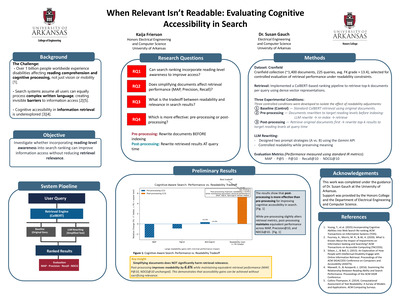
According to the World Health Organization, more than one billion people worldwide experience some form of disability. Many of them may affect cognitive processing and reading comprehension rather than vision or mobility, which creates barriers when accessing written information online. Web search is a critical modern literacy skill used for learning, decision-making, and everyday problem solving, yet most search systems are designed with the assumption that all users can process complex written language equally. As a result, people with dyslexia, other cognitive disabilities, low literacy levels, or who are English language learners may struggle to access relevant information even when it exists.This project examines how web search systems can be made more accessible by incorporating reading-level awareness into the ranking of search results. While accessibility research in computer science has traditionally focused on visual or motor impairments, cognitive accessibility and reading comprehension remain underexplored, particularly in information retrieval systems. Our goal is to investigate whether re-ranking search results based on users’ reading levels can improve access to information without reducing relevance.We design a cognitive-aware search framework that allows users to indicate a preferred reading level, such as grade level or language complexity. Documents in the search collection are indexed using an existing information retrieval model, ColBERT, and are labeled or generated at different reading levels. When suitable datasets are unavailable, large language models are used to create or find versions of documents with varying vocabulary complexity and sentence structure. We compare a standard relevance-based ranking approach with personalized ranking strategies that incorporate reading-level information.To evaluate system performance, we use established information retrieval metrics including precision, recall, and mean average precision. These metrics measure how accurately the system retrieves relevant documents and how early those documents appear in ranked results. Preliminary findings suggest that incorporating reading-level information meaningfully changes which documents are prioritized, often surfacing content that is easier to read while remaining relevant to the user’s query.In real-world settings, reading-level-aware search could support people with dyslexia, neurodivergent users, older adults, students, and individuals with low literacy, helping ensure that access to information is not limited by reading ability.
-
Effectiveness of Occupational Recommendations in Maintaining Cognitive Function Under Hot-Dry and Warm-Humid Conditions
Zane Garner
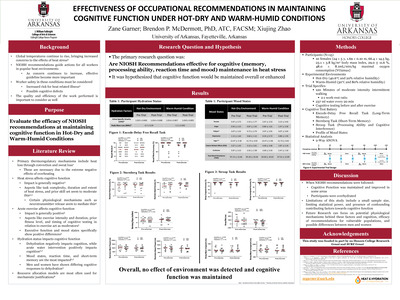
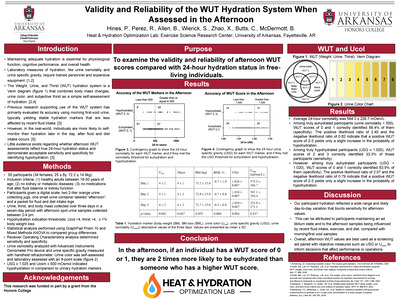
National Institute for Occupational Safety and Health (NIOSH) recommendations dictate heat safety practices in occupations throughout the United States. Currently, the effectiveness of these recommendations is unknown. Likewise, there is a lack of consensus regarding the effect of combined heat and exercise stress on cognitive function. PURPOSE: To examine the effectiveness of NIOSH heat safety recommendations in maintaining cognitive function after moderate work in the heat, alongside whether the type of heat has any effect. METHODS: A counter balanced, repeated measures, randomized controlled trial was conducted to evaluate differences in cognitive function in two distinct environments. Participants completed two experimental trials. Participants collected urine for 24-hr prior to trials to verify euhydration Urine was analyzed via urine specific gravity (USG) and osmolality. Hydration status was measured before and immediately after exercise. Participants measured nude body mass, self-inserteda rectal thermistor and donned a heart rate monitor. Thereafter, they completed cognitive testing in a hot environment. The cognitive test battery included: an encode-delay-free recall test, a Sternberg task, and a Stroop test. Participants completed these tests before and after exercise. Our two experimental conditions consisted of a warm-humid (30ºC; 80% RH; WH) condition and a hot-dry (40.6ºC; 20% RH; HD) condition. Participants exercised for 2 hours total in both conditions. Utilizing a two-way ANOVA, relationships between variables at different times (pre-exercise and post-exercise), different conditions (HD and WH), and a possible interaction of Time x Condition were explored. Variables included aspects of long-term memory, such as total recall amount and accuracy, short term memory, like accuracy and mean response time, and processing ability, including the Stroop effect. RESULTS: Specifically, no significant differences were found between WH and HD conditions or interaction of time and condition. However, significant differences were found from pre- to post-exercise in short term memory and processing capability. In terms of short-term memory, significant differences were found in mean response time for both present (p=0.030) and absent (p=0.047) Sternberg test trials, as both improved from pre- to post-exercise, although no significant difference was found in overall accuracy (p=0.515). A significant difference in Stroop effect (p=0.030), where individuals were found to decrease the difference in response times to congruent and incongruent trials from pretopost-exercise was found. No significant differences were found in long term memory overtime. CONCLUSION: Simulated moderate intensity work in HD and WH conditions did not greatly affect tested aspects of cognition, indicating that NIOSH recommendations are effective in maintaining such aspects. Identified differences are possibly due to a learning effect, as the differences improved from pre- to post-exercise. It follows that moderate work in heat environments had little negative effect. Further work should consider the possibility of eustress positively affecting cognition when effective heat stress recommendations are upheld. PRACTICAL APPLICATION: Seeing as NIOSH heat safety and hydration guidelines were effective at maintaining cognitive function during simulated moderate intensity work under hot environments, they are supported for worker safety across the country.
Printing is not supported at the primary Gallery Thumbnail page. Please first navigate to a specific Image before printing.